
How it works
A second AI checks the answer before you do.
DreamerOS is a checking layer for the AI you already use. Ask normally, a second AI checks the answer, your memory carries over, and every answer leaves a receipt you can open.
Up to five separate checkers, from five different makers, read every answer before you do.
Try it free. No card, ever.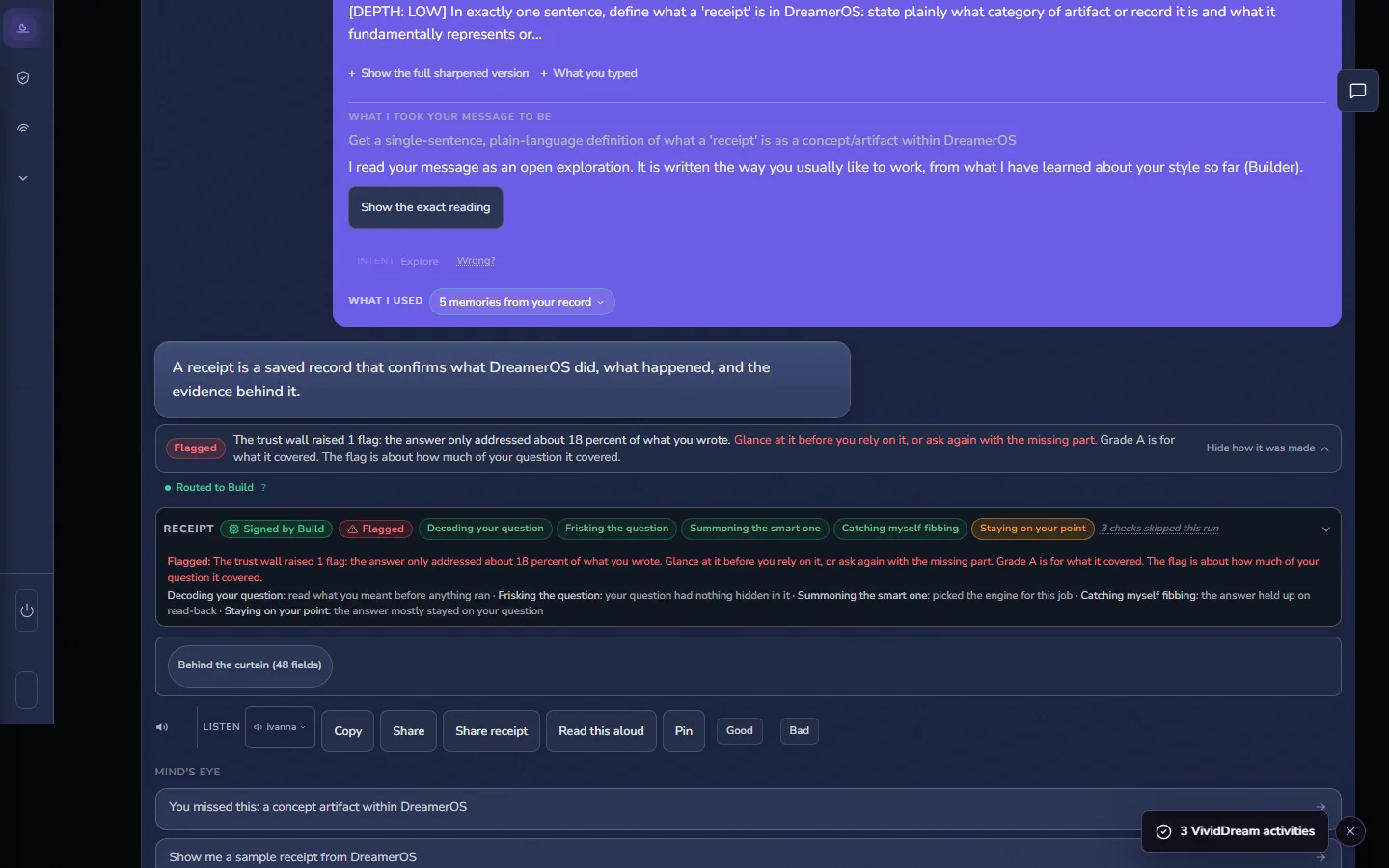
Ask
Type it messy. It builds the question for you.
This is one question moving through that pipeline, start to finish. You type a plain sentence, no brackets, no setup, no prompt engineering. DreamerOS expands it into a structured brief, fills in missing context, and sends it to the engine built for that kind of question. Ask about your business, your code, or your homework the same way. Nothing to write except the question itself.
How we do it, in pictures
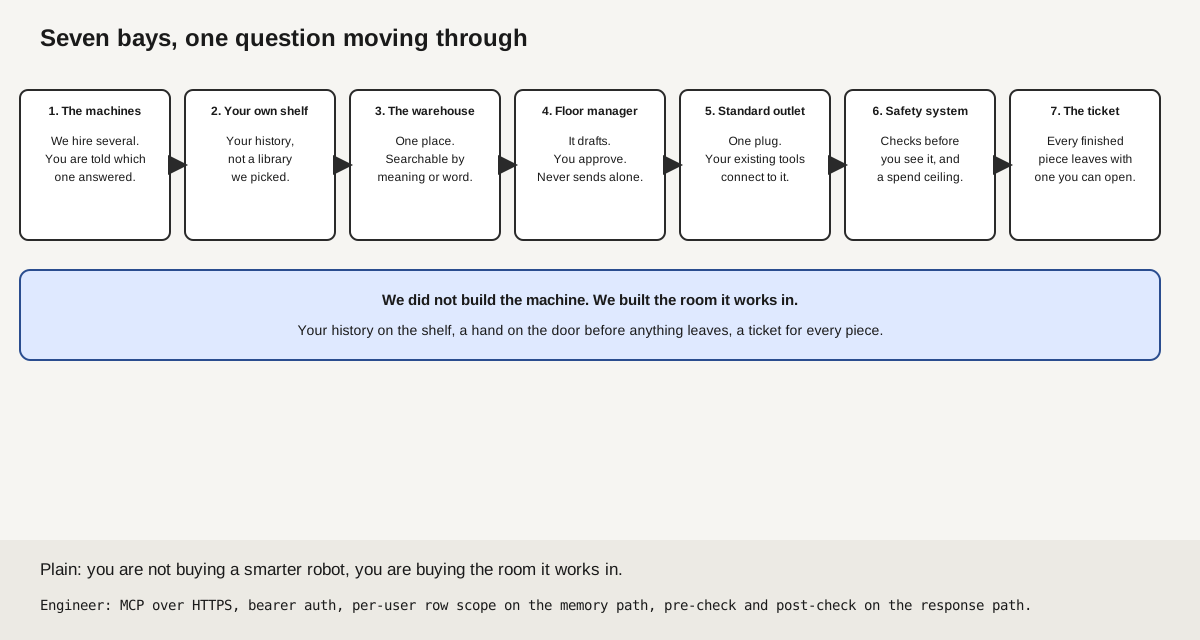 You are not buying a smarter robot, you are buying the room it works in.
MCP over HTTPS, bearer auth, per-user row scope on the memory path, pre-check and post-check on the response path.
You are not buying a smarter robot, you are buying the room it works in.
MCP over HTTPS, bearer auth, per-user row scope on the memory path, pre-check and post-check on the response path. Check
A second AI checks the answer before you see it.
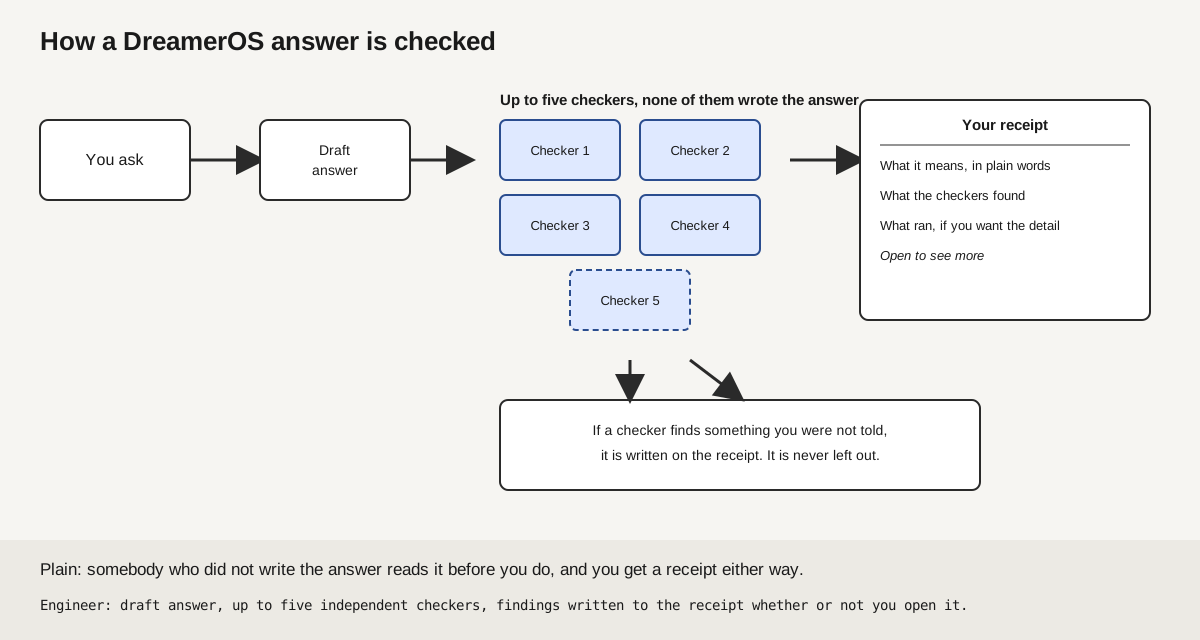
This is that check running: a draft answer being read by checkers that did not write it, before it reaches you. Up to five, from five different makers, so one company's blind spot does not slip through unnoticed. A hallucination scan, a source check, a drift check, and a confidence check that catches a guess dressed up as fact. It never deletes, spends, or sends on its own either; every action still waits for your yes.
How we do it, in pictures
 pre-check -> engine -> post-check -> record
checkers: DeepSeek, Moonshot, Zhipu, Alibaba, Mistral
no checker shares a maker with the engine that answered
pre-check -> engine -> post-check -> record
checkers: DeepSeek, Moonshot, Zhipu, Alibaba, Mistral
no checker shares a maker with the engine that answered Remember
What you said in one tool is known in the next.
This is the one memory surface ChatGPT, Claude and the web app all read from. Tell ChatGPT your deadline on Monday. Open Claude on Wednesday and it already knows. You do not re-explain yourself, and nothing leaves your hands on its own either: a connected tool acts only after DreamerOS checks it against what you actually asked. The memory is yours, not the vendor's, and it comes with you if you ever leave.
How we do it, in pictures
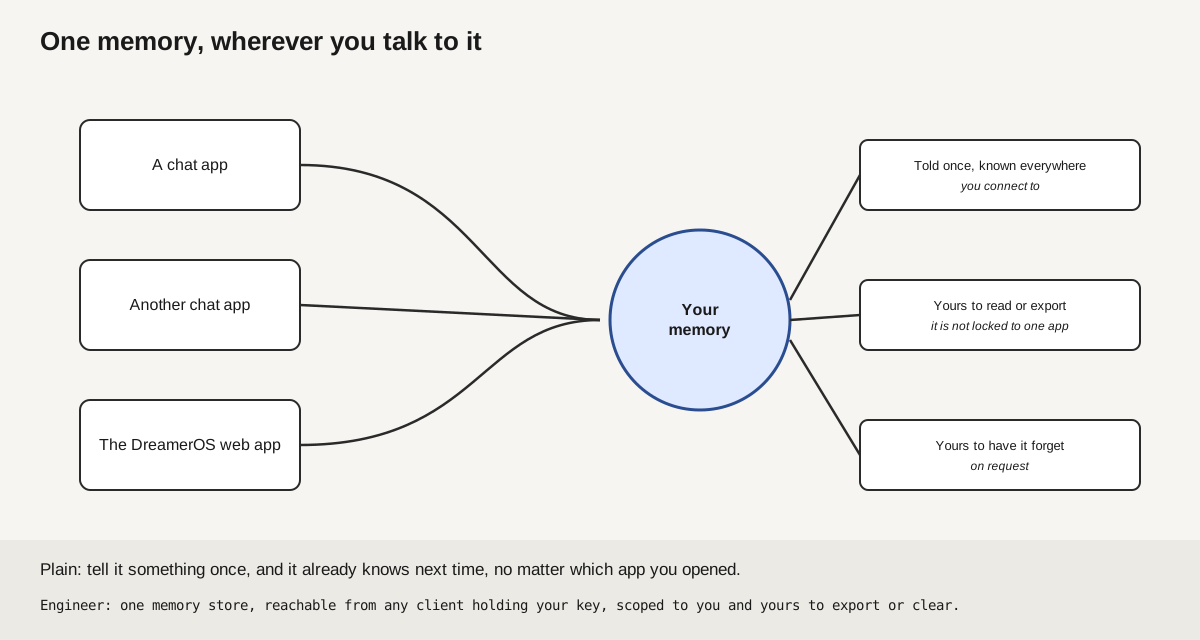 one memory store, reachable from any client holding your key
rows per plan: 100 / 1,000 / 1,000 / 10,000 / 100,000
unapproved and unclassified connector actions are held, not run; connector reads are fenced as data, never as instructions
one memory store, reachable from any client holding your key
rows per plan: 100 / 1,000 / 1,000 / 10,000 / 100,000
unapproved and unclassified connector actions are held, not run; connector reads are fenced as data, never as instructions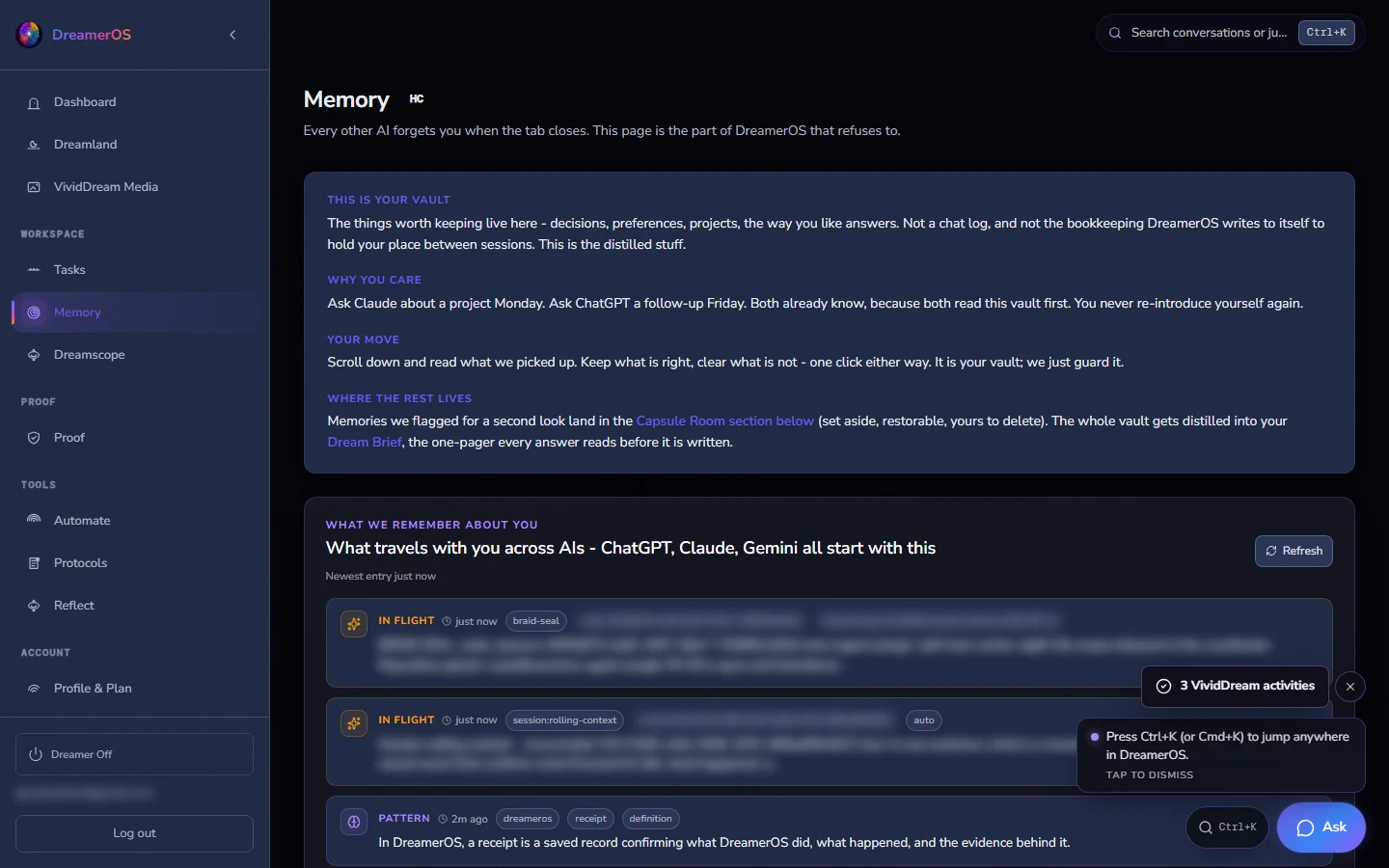
Proof
Every answer leaves a receipt you can open.
This is one such record, open. Each answer writes one row: which engine answered, what it cost, which checks ran and what they found. The record renders in three layers, plain words first, so you stop reading at the layer you need. Hand it to anyone. It does not need us to be believed.
How we do it, in pictures
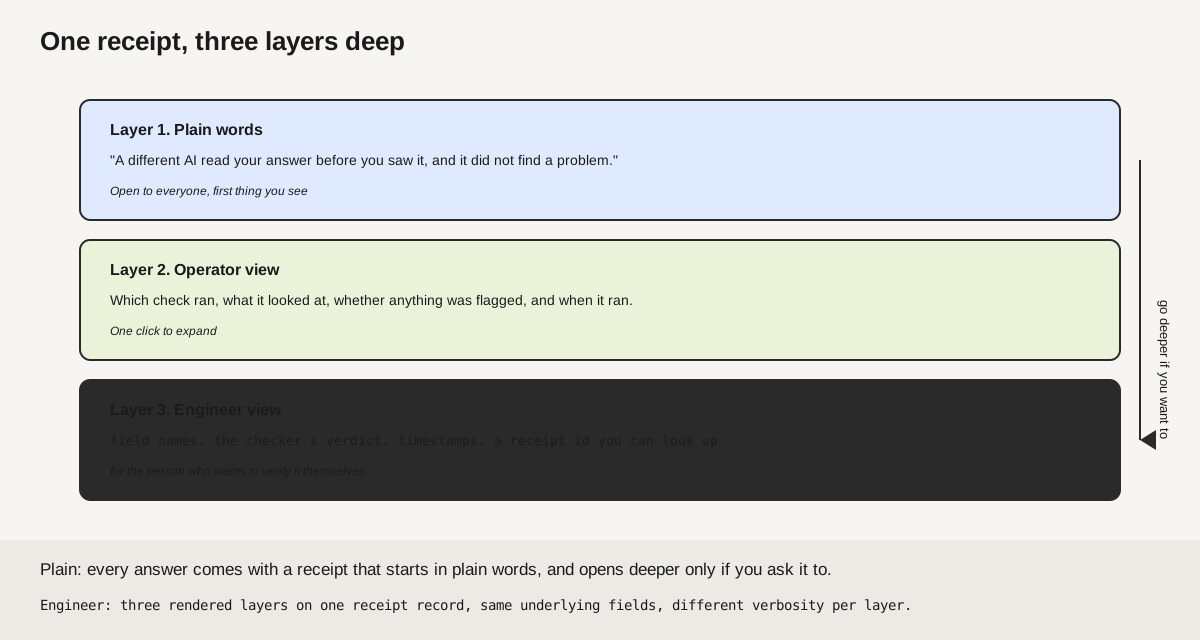 one row per answer: engine, model, cost_usd, pre-check status, post-check status
three layers are rendered from those fields, no extra model call
read them at app.dreameros.app/trust
one row per answer: engine, model, cost_usd, pre-check status, post-check status
three layers are rendered from those fields, no extra model call
read them at app.dreameros.app/trust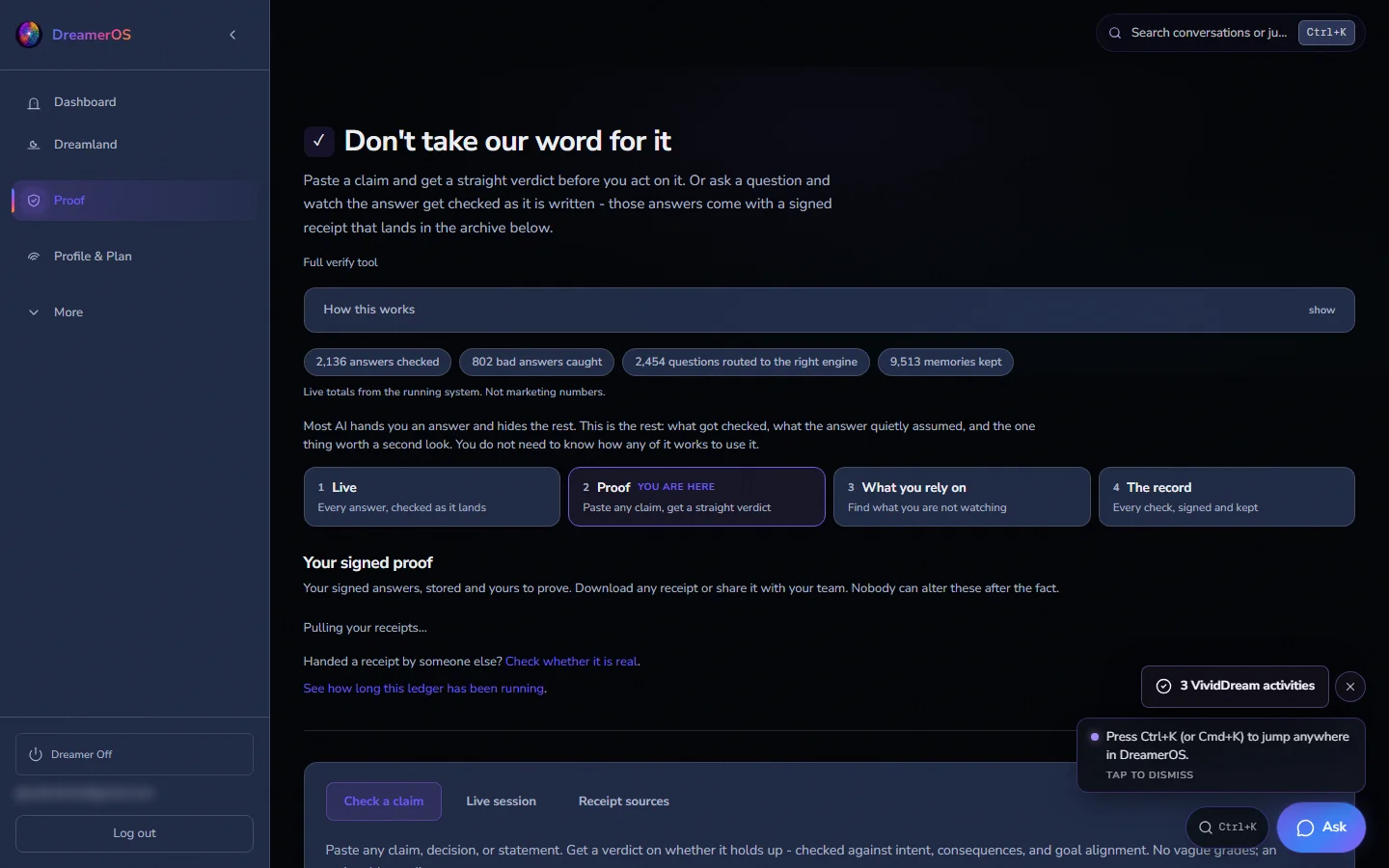
When you want the full picture
You can start with the plain version and keep going only when it helps. The next layer is here: how DreamerOS keeps the answer pointed at what you meant, the parts working together underneath, and checked answers you can inspect for yourself.
More detail
Four invisible layers between your question and the answer.
Most AI tools give you a text box and leave the rest to chance. DreamerOS runs every input through a structured pipeline. It expands your intent, sends it to the right engine, checks the output for accuracy, and surfaces the follow-up questions you did not know to ask.
Want the short version? Infinite Prompts - see DreamerOS in 60 seconds on the start page.
What the terms on this page mean
If you are new to AI, none of this matters - the pipeline works whether you understand it or not. If you want the shorthand: Question shaper is the layer that turns your messy sentence into a structured brief. Integrity checks scan the answer for the most common AI failures before it reaches you. Intent fidelity is the rule that the final response must match what you actually asked - not just what you typed. Engines are different reasoning paths the same input can take, selected automatically. Memory is the layer that holds what you decided across every AI tool you use.
None of this is visible when you use DreamerOS. This page exists for people who want to see what is happening under the hood.
Same question. Wildly different answer.
Intent checks built into every layer change what comes back. The models are good. The structure around them is not. Modern AI can reason, create, and analyze, but it ships without structure. The quality of what you get depends entirely on the quality of what goes in.
DreamerOS exists because these are architecture problems, not intelligence problems. The models are capable enough. They just need structure around them.
Raw AI vs DreamerOS, side by side
Both get the same prompt: "help me with my business".
Raw AI: Sure! Here are some general tips for improving your business: 1. Focus on customer satisfaction. 2. Use social media marketing. 3. Track your finances. 4. Network with other professionals. 5. Consider hiring help. Generic. No context. No structure. No follow-up.
DreamerOS:
- Quick answer. Before optimizing anything, identify your single biggest constraint right now - is it leads, conversion, retention, or capacity? Fix that first.
- Deep dive. Diagnostic framework: Revenue = Traffic x Conversion x Average Order x Frequency. Which variable is weakest?
- Follow-up forecast. You probably also need: competitor pricing analysis, customer churn rate calculation, and a 90-day cash flow projection.
Structured. Actionable. Anticipates your next question.
The four failure modes of raw AI
- Failure mode 1 - Prompt fragility. Change one word and the output changes completely. People spend more time crafting inputs than using the answers they get back.
- Failure mode 2 - Confident hallucination. Models make things up with the same tone they use for verified facts. There is nothing built in to tell you which parts are real.
- Failure mode 3 - Session amnesia. Every conversation starts from scratch. Context from previous sessions disappears. Decisions you made yesterday are gone today. What this looks like: Monday you spend an hour with ChatGPT deciding on your pricing tiers. Tuesday you open Claude to draft the launch email. Claude has never heard of your tiers. You start over.
- Failure mode 4 - No quality gate. AI code tools run through automated quality checks before anything ships. For everything else AI produces - strategy, research, analysis, decisions - there is no check at all. Output goes straight from generation to your deliverable. DreamerOS is that missing check.
What happens after you hit send.
Six steps between your messy thought and a structured, checked, layered response. All invisible. All automatic.
The six steps, one by one
- Input - you type naturally. No brackets, no syntax, no system prompts. Type "help me figure out if I should hire" or "explain quantum computing to a 10-year-old." DreamerOS takes natural language as-is. This is what Infinite Prompts means - there is no wrong way to ask.
- Layer 1 - Question Shaper. Your question gets a structure. The question-shaping layer takes your raw input and expands it into a structured brief. It identifies your goal, fills in missing context, and selects the right thinking mode. You never see this step - but it is the reason a 7-word question produces a strategy document. This is what makes DreamerOS promptless.
- Layer 2 - Engine selection. The task goes to the right engine. DreamerOS picks the thinking mode and domain module for each task. A business strategy question travels differently than a code debugging question. The selection is automatic and invisible.
- Layer 3 - Integrity checks. The output gets checked. The integrity layer scans for fabricated claims, flags unsupported assumptions, detects drift from your original intent, and catches silent drops - where content gets cut without telling you.
- Layer 4 - Forecast. The system predicts what you forgot to ask. The Follow-Up Forecaster finds gaps you did not know were there. It surfaces adjacent questions, blind spots, and next steps before you have to come back for them.
- Output - a layered answer comes back. Every response arrives in three layers: Quick Answer (the direct, actionable take), Deep Dive (structured reasoning and frameworks), and Follow-Up Forecast (the questions you should ask next). All checked and verified by Digital Buoyancy.
The numbers behind the pipeline
- 0 prompts to write. The question shaper builds every prompt behind the scenes.
- 6 thinking modes. Sandman, Founder, Architect, Precision, Research, Recovery.
- 8 domain modules. From data research to business strategy to content and code.
- 30+ safety constraints. Enforced rules built into every layer - not suggestions.
One question through the full pipeline.
Seven words in. Three layers out. No prompt engineering.
The worked example, in full
You: How do I stop losing clients?
- Quick answer. Most client loss is a delivery problem, not a sales problem. Audit your last 5 lost clients for the real exit reason before changing anything about acquisition.
- Deep dive. Three-phase retention framework: (1) exit interview the last 5 churned clients to find the pattern, (2) map your delivery against their stated expectations at signup, (3) build one automated touchpoint at the moment risk spikes highest - usually 30 days post-onboarding.
- Follow-up forecast. You probably also need: a pricing analysis (underpriced clients churn faster), a scope-creep boundary template, and a 90-day check-in script that re-sells the value before renewal conversations start.
Prompt shaped. Output checked. Mode auto-detected. 0 prompts written.
What powers the pipeline.
Three engines handle different dimensions of thinking. They run together on every request, out of sight. You do not need to learn prompt engineering to use any of them. Just ask a question.
The three engines, in full
Endless Dream Engine - promptless scaffolding. The question shaper takes your natural language and turns it into structured reasoning the model can act on - adding context, selecting modes, building the brief. You type a messy thought. It becomes an expert-level prompt, behind the scenes, before the model ever sees it.
- Automatic thinking mode detection
- Context expansion and scope clarification
- Domain module selection
- Invisible to the user by design
- Structured prompts produce better results in fewer tokens, which keeps cost down
Integrity Machine - safety wrapper. The Integrity Machine wraps every response with hallucination detection, drift prevention, and assumption checking. Claims get checked. Assumptions get flagged. If content gets cut or skipped, you hear about it.
- Hallucination reduction on every output
- Drift detection across conversations
- Silent-drop prevention
- Assumption flagging via ZAP, the Zero-Assumption Protocol - DreamerOS asks when it does not know rather than guessing
Follow-Up Forecaster - gap predictor. The Forecaster analyzes your question and finds what you did not think to ask. It surfaces blind spots, adjacent concerns, and logical next steps - the part of DreamerOS users mention most often.
- Predicts missing questions
- Surfaces blind spots and related angles
- Proactive next-step suggestions
- Reduces back-and-forth dramatically
You do not need to learn prompt engineering
Just ask a question. DreamerOS handles everything else. And as you use it, you will pick up how AI actually works - because every answer shows you the structure behind it.
- Step 1 - New to AI. Start with DreamerOS Light - it is free. Ask about anything: business, homework, health, creativity. No setup required.
- Step 2 - Getting comfortable. Try different types of questions. Watch how the layered answers push your thinking further. The Quick Answer, Deep Dive, and Follow-Up Forecast structure makes the reasoning visible.
- Step 3 - Power user. Explore Pro features. Build workflows. Understand the architecture. Deploy AI agents. You did not have to study - you got here just by using it.
Use DreamerOS inside ChatGPT
Already use ChatGPT? Keep it. DreamerOS adds integrity checking on top. The DreamerOS GPT runs inside chatgpt.com. Search for "DreamerOS Infinite Prompts" in the GPT Store, click it, and sign in with your DreamerOS account. Your tier activates automatically.
- Light (free) - Integrity checking at the Light tier, no account required
- DreamWeaver Solo ($14.00/mo) - Full intent verification for one engine of your choice
- DreamWeaver Duo ($24.99/mo) - Two engines, memory syncs across both
- Pro ($39.99/mo) - All five engines, full cross-engine memory, complete pipeline
Same ChatGPT interface. Better answers. Memory that holds across sessions and across engines.
What DreamerOS will not do.
More than 30 active safety constraints. Not guidelines - enforced rules built into every layer of the pipeline.
Accurate over fast. Explicit over implicit. Durable over clever.
The four holds, in full
- No guessing. The Zero-Assumption Protocol means DreamerOS asks when it does not know. It never fills gaps with invented answers.
- No silent drops. If something gets cut, skipped, or simplified, you are told. Nothing disappears without a note. Completeness is tracked.
- No unchecked output. Integrity checks catch fabricated claims before they reach you. Every output passes through the integrity layer.
- Digital Buoyancy. Every interaction is authenticated, authorized, and accounted for. Who asked, what was allowed, what happened - all tracked. You own it.
Eight pictures, no internals. One line each for the engineer who wants it.
Eight pictures showing what runs behind a DreamerOS answer: what checks it, what it never does alone, and where your money and your memory stop and start. No file names, no model names, nothing you would need to be an engineer to read, and one line for the engineer who still wants it.
- How a DreamerOS answer is checked. Somebody who did not write the answer reads it before you do, and you get a receipt either way. Draft answer, a five-checker pool works the turn, findings written to the receipt whether or not you open it.
- What it never does without you. It will not spend, send, or act past what you allowed, and it will never hide a check that failed. Unapproved and unclassified actions are treated as write-class and held; content it reads is fenced as data, never as instructions.
- Memory follows you, not the app. Tell it something once, and it already knows next time, no matter which app you opened. One memory store, reachable from any client holding your key, scoped to you and yours to export or clear.
- A connected tool, held to its rules. Reading carries on and tells you what it found. Sending, posting, or deleting waits for the safety check to pass. Read-class actions fail open with a status note; write-class actions fail closed, and an unrecognised action is treated as write-class.
- One receipt, three layers. Every answer comes with a receipt that starts in plain words, and opens deeper only if you ask it to. Three rendered layers on one receipt record, same underlying fields, different verbosity per layer.
- Where your money stops. Your plan has a daily ceiling. When it is reached, the work stops, and you are not billed past it. A per-tier daily spend ceiling is enforced before the call runs, not reconciled after the fact.
- Seven bays, one question moving through. You are not buying a smarter robot, you are buying the room it works in. MCP over HTTPS, bearer auth, per-user row scope on the memory path, pre-check and post-check on the response path.
- The free stack, and what we add. The free stack gets you started. We built the part that keeps working after the demo ends. Inference and storage are free; per-call verification, per-user budget ceilings, and a portable memory contract are not.
What to do next.
DreamerOS Light is free. Use the GPT version or the web app. No credit card. Ask one real question and watch the pipeline run.
Three doors from here
- Try it yourself. DreamerOS Light is free. Use the GPT version or the web app. No credit card. Try DreamerOS free DreamerOS GPT
- See the technical details. Under the Hood goes deeper into the architecture - modules, engine selection rules, engine specialization, and how the intent verification layer works. For developers
- Compare the tiers. Light is free. Pro adds memory, full integrity checking, and multi-engine selection. Elite adds agents and custom modules. Compare plans
Works inside the tools you already use
DreamerOS connects to your AI tools as an MCP connector. The integrity pipeline runs wherever you already work - no app switching, no workflow changes. Same tool, checked output.