DreamerOS
Verified AI

The AI that shows its work.

DreamerOS is the intent-verified AI operating system. Every answer runs integrity checks before you see it. Open any response and see exactly what it survived, which claims got verified, and what to watch for before you act on it.

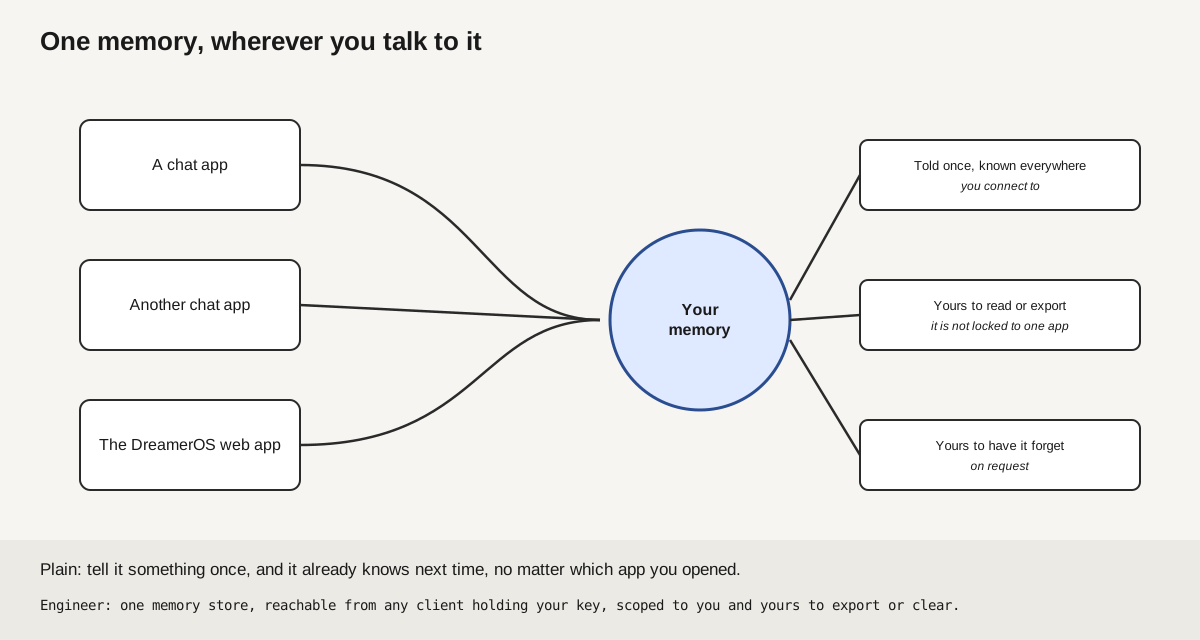
Used inside ChatGPT, Claude, and the DreamerOS web app. Jump from one to the next and it still knows how you think, because the memory is yours, not theirs.

5
engines, one checked answer
1
receipt on every answer
25
operator skills
70+
tools it works with
Live Preview
You type
DreamerOS processes
DreamerOS delivers
Quick take You are in a classic plateau-or-pivot moment. Here is how to tell the difference.
Deep analysis Three diagnostic questions to separate emotion from data...
Follow-up forecast "You did not ask about your customer retention rate, but that is where the answer lives."
Looking for the quick version? Infinite Prompts - see DreamerOS in 60 seconds

You already know how to say what you mean.

The problem is not your phrasing. The problem is that nothing on the other end knows how to hear it. Every new chat forgets your name, your context, your preferences, and the three things you said last Tuesday. You are not bad at prompting. You are talking to something built to forget you the second the window closes.

Monday you tell ChatGPT your daughter's name is Mira and she turns six in April. Wednesday you switch to Claude and ask for a six-year-old's birthday card. The card says "Happy birthday, Mira." That is not the model being smart. That is you doing the remembering, both times. DreamerOS holds the thread across every tool so you do not have to. The memory follows you, not the vendor.

If you have never used AI before: try the free tier, ask it the messiest question you have, see what comes back. If you have used AI for years and you are tired of starting over: this is the layer that was always missing.

You don't trust AI? It's ok, neither do we.

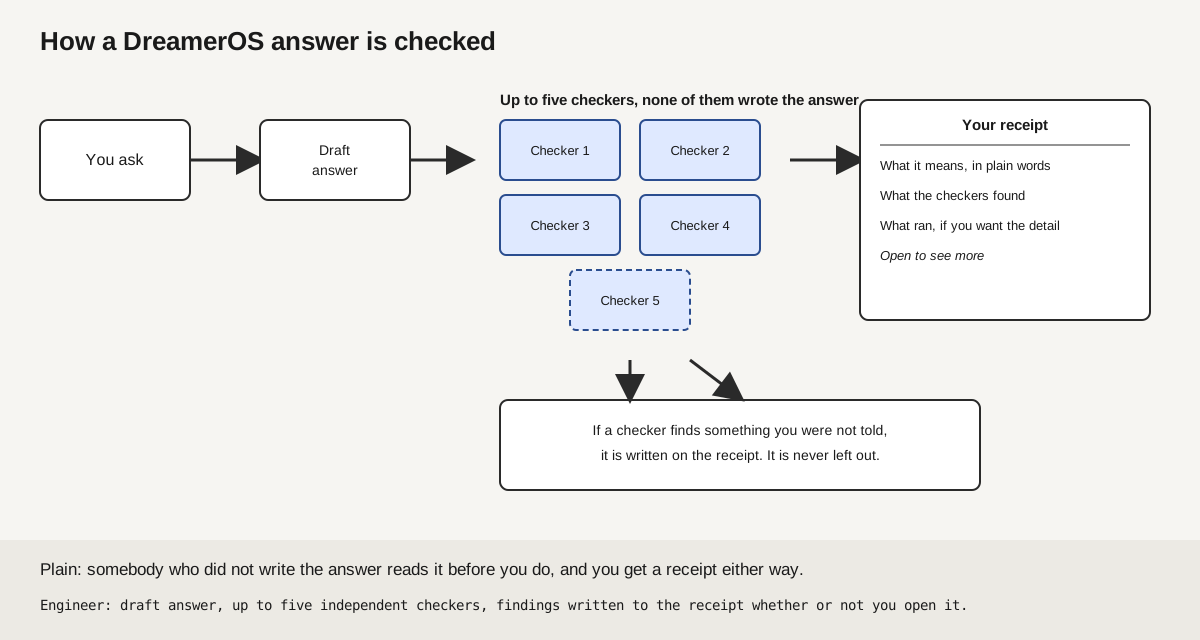
That's exactly why DreamerOS exists. Every answer comes with a receipt. You see which engines checked it, what they looked for, and whether they agreed. Nobody asks you to trust anything here. You get something you can check yourself, which is the only kind of trust worth having.

Where do I start?

Sign up, type a question. No configuration. No API key. No setup. You will have an answer - and a receipt for it - in under a minute.

Why connect other AI tools?

DreamerOS checks answers across multiple AI engines. Connecting one like Perplexity adds real-time fact checking. You don't have to. It just makes answers harder to get wrong.

I already use ChatGPT. Why this?

Keep it. We are the layer that catches what it ships wrong. Connect the tools you already pay for and the trust layer plus your memory follow you everywhere you work. You bring the tools. We bring the check, and we remember how you think.

Why would I pay for more connectors?

More connectors means more engines independently checking the same answer. Pro and Elite tiers check more things, in more ways, with more engines. Every tier starts free.

Start in 30 seconds. No API key needed.

Sign up with your email. Ask anything. See the receipt. That is all there is to it.

Let us help you trust again

Works with your AI

One connection. Every AI tool you already have open.

Connect once. Everything that passes through the middle is checked before it counts as done.

Claude Desktop ChatGPT Cursor VS Code Windsurf bring your own MCP + API
DreamerOS
Gmail GitHub Linear Railway X / Twitter outgoing: checked answers

Works with your AI

Bring the tools you already use.

DreamerOS sits beside your AI and your workspace. Nothing to rip out, nothing to relearn.

ClaudeChatGPTGeminiGrokPerplexityCursorClaude Code
NotionSlackGitHubGmailGoogle DriveGoogle CalendarLinearFigmaCanvaStripeAirtable

Already running your own setup? Plug it straight in.

Point any MCP client at DreamerOS, or drop in your own API key and keep your model. Building something? There is a real developer kit: npm install @dreameros/sdk.

Operator skills

Twenty-five skills. One for every time you are not sure the AI got it right.

These are not settings to configure. They are checks you run. Paste an answer, pick the one that fits what you are unsure about, get something you can act on. Some you will use every week. Some you will need once and be glad they exist.

Fact Check
The answer sounds right. This asks for proof.
Prove It
No source, no claim. Every fact gets traced back to something real, or it gets flagged before you quote it and look silly.
Poke Holes
Let's poke some holes in it. The AI argues against its own answer, hard, so the weak spots show before you bet on them.
Danger Scan
Three ways this goes wrong, ranked worst first. Read it before you commit, not after.
Yes Man Check
Your AI has been nodding a lot lately. This counts how often it just agreed with you, and shows where it should have pushed back.
Too Sure
Confident voice, shaky facts. This catches the AI sounding certain about things it has no business being certain about.
Caught Lying
Long sessions drift. This finds where the AI contradicted itself and names which claim should have given way.
Show My Work
Rebuilds the full chain - question, response, decision - so there is a record when someone asks how you got here.
Still True
The claims from earlier are still shaping your direction. This checks which ones were asserted but never verified.
Hidden Guesses
Before you send the prompt, this surfaces what you are treating as settled that may not be.
Honest Score
After the project: what the AI got right, what it missed, what you corrected. A record, not a verdict.
Save My Place
End of session, this compresses the context into a handoff brief. Paste it at the top of the next one. No cold start.

The trust loop

Ask. Check. Keep the receipt.

DreamerOS does not just answer. It shows its work and keeps a record you can hand to anyone.

Paste it. Check it.

Drop in a claim or a decision and get it checked before you act on it.

A verdict you can use

Multiple engines weigh in, then DreamerOS returns one checked answer you can act on.

No silent guessing

When it is not sure, it tells you it is not sure instead of bluffing.

Every answer, signed

Every verified answer is signed and stored, so the record exists before anyone asks for it.

Hand over the receipt

When somebody asks how you know, you hand them the receipt instead of an explanation.

Yours to keep

The record stays with your account, not locked inside one chat window.

See the checks

Open any answer and see the checks it passed on the way to you.

See the sources

Every fact traces back to a real source you can open yourself.

Nothing hidden

The trail is the proof. What it checked and what it used, in one place.

Same question. Wildly different experience.

See what happens when integrity checks are built into every layer.

Raw AI
"ugh so my boss wants me to figure out if we should switch to postgres or keep mysql, we have like 50k users and its getting slow"

Sure! Here are some things to consider when choosing between PostgreSQL and MySQL...

1. PostgreSQL has better JSON support
2. MySQL is more widely used
3. Consider your team's experience
4. Both are open source
5. Performance depends on use case

Generic. No context. No urgency. No decision framework.

vs
DreamerOS
"ugh so my boss wants me to figure out if we should switch to postgres or keep mysql, we have like 50k users and its getting slow"
Quick answer

At 50K users with performance degradation, migrate to PostgreSQL -- but the Q3 deadline is the real constraint. Start with a read-replica strategy while planning the full migration.

Deep dive

Decision framework: current bottleneck analysis, migration complexity score, team readiness assessment, and phased rollout plan with rollback strategy...

Follow-up forecast

You probably also need: a load testing plan, connection pooling strategy, and a cost estimate for managed PostgreSQL hosting.

Structured. Actionable. Anticipates your next question.

Your AI. She's lying to you.

Not maliciously. Not even knowingly. She is the friend who says sorry for the exact thing she is about to do again a minute later. The gap between what she says with confidence and what she actually knows is wider than any AI company will put in an ad.

She agrees with you too much

Ask a model "are you sure?" after it gives a correct answer and it caves. In one study, a leading assistant changed its right answer 86% of the time and apologized for a mistake it never made 98% of the time. OpenAI rolled back its own update for being "overly supportive but disingenuous" and said "we fell short." She is not agreeing because you are right. She is agreeing because agreement feels safe.

DreamerOS runs a second independent check on every answer. It does not know what the first one said. If they disagree, you see both verdicts.

She is most confident when she is most wrong

The AI voice is identical whether it just looked something up or just invented it. In 2025 alone, an audit of 111 million references found 146,932 fabricated citations entering scientific databases - delivered in the same authoritative tone as the real ones. Hedge language is trained out because it sounds weak. You have no way to tell the difference from tone alone.

A confident-fabrication scan runs on every output - flagging claims stated as fact that cannot be grounded. If something fails, the flag surfaces inline, not buried in a disclaimer.

She forgets everything the moment you close the window

What feels like a conversation partner is a stateless process that resets every session. Researchers call it "lost in the middle" - models drop information buried in long context, with accuracy falling 20 to 50% past 100K tokens. The continuity you feel is you doing the remembering, both times.

DreamerOS injects your cognitive fingerprint - the running picture of how you think and what you have already decided - plus the memory that matters into every engine call. The context you built last week travels forward. You do not start over.

She does not know what she does not know

Every AI has a coverage horizon - topics it has seen enough of to answer well, and topics where its training was thin. It answers both kinds the same way. You get no signal about which side of that line your question landed on. You only find out when something downstream breaks.

A coverage check opens an interactive loop when confidence drops below threshold - asking you targeted questions to surface what the AI was not equipped to answer on its own.

Every number here is real and sourced. See the receipts.

You don't trust AI. That's ok. We don't either.

That is the whole reason this exists. We love what these models can do. We also watched them make things up with a straight face, agree with us to be nice, and forget everything the second the chat closed. Meanwhile 64% of teens now use these tools and nearly 1 in 5 lean on them for mental health advice - most having told no one. So we did not build another model. We built the part that double-checks the one you are already using - because somebody had to, and it was clearly not going to be the model. Trust is a feeling. Verification is a process. We picked the process.

It reads what you actually meant

You type like a human - half a thought, a typo, the gist. We work out what you were really asking before the question goes out, so you are not punished for not talking like a prompt engineer.

It asks more than one

One model, one blind spot, full confidence. So we ask several and give you the part they all agree on. Turns out "let me check with the others" works on robots too.

It checks the answer and hands you the receipt

Every answer gets put through its paces before it reaches you, and you walk away with a receipt of what held up and what got flagged. Next time someone asks "are you sure," you have the file. They will stop asking.

Here is the part we will not pretend about. The big AI companies will never do this. None of them will check their own homework against a rival, and none of them want you using five tools at once when they would rather you used one. We compete in the exact gap their own incentives keep them out of. You stay the one who decides. The engines just do the work. The system makes sure they did it right.

How the process works under the hood is ours, and we are keeping it that way - you do not need to see the wiring to know the lights come on. You just need the answer to be right, and to know it was checked before it got to you.

The pipeline

Every message takes the same three steps.

Your messy input goes in. A checked, sourced answer comes out. Here is what happens in between.

You type ugh should we switch to postgres
Question shaper Layer 1 - intent locked Should we migrate from our current database to PostgreSQL? What are the tradeoffs for our stack?
5 engines Layer 2 - Build / Review / Synthesis / Signal / Research
Build Research Review Synth Signal
Integrity checks 7 before, 15 after
! hallucination caught: confident guess ! fabrication caught: confident guess drift monitoring source verification intent match
Checked answer + receipt (Pro & Elite)
Postgres is worth it if you need JSONB queries or row-level security. Here is what changes for your stack. receipt attached

Three layers. Every response.

Every message passes through three integrity layers before the output reaches you. Not optional. Always on.

The question shaper restructures

The question-shaping layer takes your messy input and rebuilds it into a structured, domain-aware prompt. 12 enrichment layers including context loading, risk awareness, and confidence calibration.

Engine generates

Your restructured prompt routes to the best engine for the task. Five engines with different strengths: Build, Review, Synthesis, Signal, Research. The right engine gets the right question every time.

Integrity checks verify the output

Twenty-two integrity checks on every response - seven before the engines answer, fifteen after. Hallucination detection, confident fabrication, drift monitoring, scope creep flagging, silent drop catching, PII scan, and more. If something fails, you see it.

Voice input on every tier. Premium speech responses on Pro and up.

Speak naturally. Mumble, ramble, change your mind mid-sentence. DreamerOS transcribes, restructures, and applies the same integrity checks it applies to text. Every tier gets voice input and spoken playback; Pro and up add premium speech responses. Your voice goes in messy. Expert output comes back clean.

Describe the picture. Get the picture you meant.

Most image tools take your words literally and hand back something almost right. VividDream runs your description through the same intent restructuring as chat before anything generates, then checks the result against what you asked for. Plain words in. A sharpened, checked image out.

Image Create - live today

Open the app, describe what you want to see, get the image. Live now on every tier, free tier included. Your description is sharpened before generation and the result is checked against the ask. Monthly creation limits scale with your tier.

Image Edit - coming as wired

Hand it an image and an instruction instead of regenerating from scratch. The surface is built; the capability switches on as it is wired. Not live yet, and we will not pretend otherwise.

Video Create and Edit - coming as wired

The same sharpen-then-check pipeline, pointed at video. Wired behind the scenes, switched on when it is ready. Coming as wired, not sold as live.

On Elite, the 3-engine vision critique is live and the iterative vision critique loop is coming as wired. See Elite. The full moat - calibration, cache economics, governance portability - is laid out on the moat page, which also names three categories we are defining: Modality-Routed Governance, Connector As Turn, and the Sense-Agnostic Integrity Protocol.

Eleven operator skills. They run where you already work.

DreamerOS ships 11 operator skills: done-gates that block premature "finished" claims, drift checks, failure forecasts, causal traces from a production symptom back to the decision that caused it, and more. The full catalog is listed in the app.

Said plainly: these skills do not run in your browser. They run inside Claude Code or claude.ai sessions connected to DreamerOS through your API key. You connect once, and the skills carry your memory and integrity checks into the tool you are already sitting in.

See all 11 skills

The receipt

What a checked answer looks like.

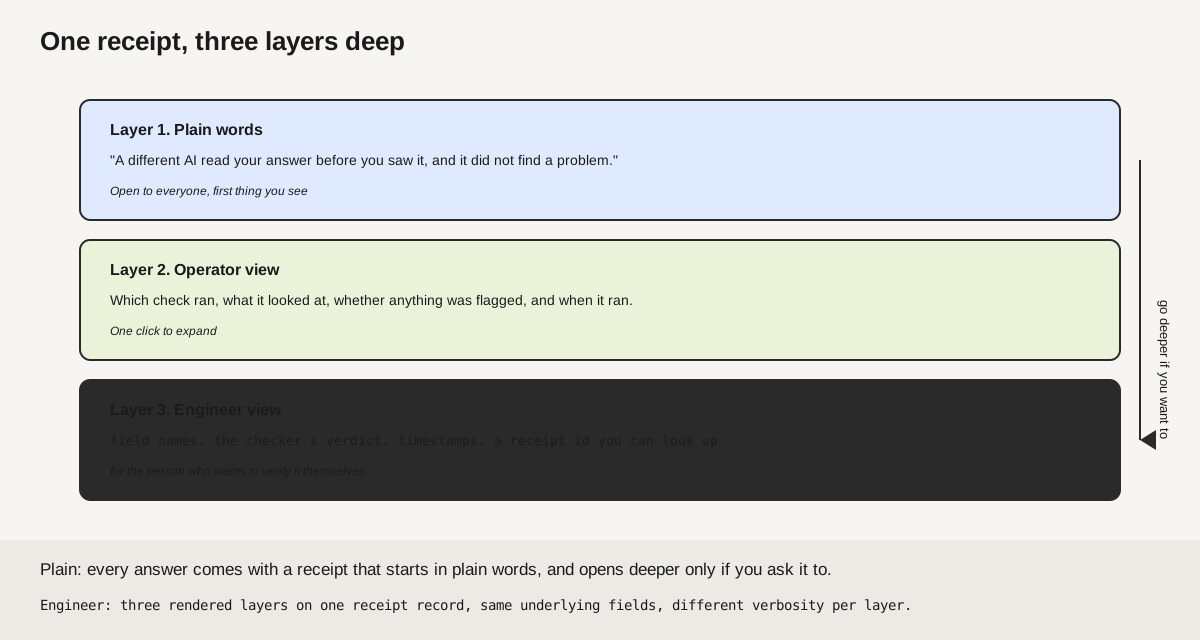
Every answer ships with a paper trail. This is what it carries.

DreamerOS
Verified answer Pro & Elite PASSED RCPT-7F2A . 2026
Claim checked

"Postgres is the better choice at 50k users."

Checks run
Hallucination scan
PASS
Source check
3 sources
Drift monitor
clean
Confidence calibration Confident guess detected - downgraded to verified claim
caught + fixed
Sources
postgresql.org/docs db-engines.com/ranking pganalyze.com/blog
5
engines, one checked answer
1
receipt on every answer (Pro & Elite)
25
operator skills
70+
tools supported - and vendor-agnostic

Numbers we can actually back up. Unlike the AI.

0
Prompts to write
The question shaper handles all prompt construction internally
5
AI engines connected
Build, Review, Synthesis, Signal, Research
12
Question-shaping layers
From context loading to confidence calibration
10
Integrity checks
Every output scanned before it reaches you

Your AI finally has a memory

Every AI chat resets. DreamerOS does not. Your decisions, preferences, and context carry across sessions and across engines, so what you tell one engine, every engine knows. Tell ChatGPT something on Monday, ask Claude about it on Wednesday, and it is already there. The memory belongs to you and travels with you, not locked inside one company's app.

Available on Pro and Elite tiers. See what Pro includes.

Built for how you actually use AI

Whether you are writing your first prompt or managing a team of engineers, DreamerOS meets you where you are.

People who want better answers

You do not need to learn prompt engineering. Type what you mean in your own words. DreamerOS handles the translation.

Builders and developers

Architecture decisions, code review, debugging. Five engines with different strengths. Route the right question to the right engine every time.

Business professionals

Strategy memos, market research, decision analysis. Every output checked and verified. No hallucinated data in your deliverables.

Content creators

Blog posts, marketing copy, social media. Memory-aware so your brand voice stays consistent across sessions and platforms.

Researchers and learners

Deep dives with integrity checking. A second engine checks the claims on its own, without seeing the first verdict. And it surfaces the question you did not know to ask before it bites you.

Small business owners

You keep hearing about AI but do not know where to start. DreamerOS Light is free. Ask one question in your own words. See what comes back.

We do not just prompt better.
We fixed the reason AI keeps misreading you - then we left a receipt every time it got it right, because somebody should.
The DreamerOS Thesis

Start free. Scale when ready.

Every tier runs on the same integrity architecture. The difference is depth.

Light
Free
One engine. Memory across sessions. Audit trail. 3 free Pro tool uses per cycle.
See Light
DreamWeaver Solo
$9.99/mo
Take one engine seriously. Pre-check and post-check on every answer.
See Solo
DreamWeaver Duo
$14.99/mo
Two engines that share what they know.
See Duo

Upgrade or downgrade any time. No lock-in.

One question. Your words. Right now.

Type something messy. See what comes back. If it helps, you will feel it before the minute is up. If it does not, you have lost a minute and learned where the bar is.

Free to start. No credit card required. Cancel anytime.

Ready to try? Start free. Try DreamerOS free GPT Version
98