DreamWeaver
Keep your AI tools. Add intent verification.
DreamWeaver is the way an existing AI client can use DreamerOS without replacing your workflow. It connects the client to the DreamerOS tool and continuity layer through the setup available for your account.
The short version: keep the AI client you already use and add DreamerOS where the live connection supports it. Available checks, tools, and memory actions depend on your tier, client, connection health, and the capability returned for your account.
Intent verification is shown when the live session returns it. How the Intent Fidelity Protocol works
Intent Verification that rides on top of your AI
DreamWeaver is a DreamerOS connection path for the AI tools you already use. Your account tier and the connected client determine what setup, tools, memory actions, and receipts are available. The authenticated Connect page shows the current capability for your account before you use it.
How DreamWeaver works on ChatGPT
Five steps. Under two minutes.
Open the DreamerOS GPT
Go to DreamerOS Infinite Prompts in the ChatGPT GPT Store. Click it to start a conversation.
Sign in with your DreamerOS account
The GPT prompts you to authenticate. Use your existing DreamerOS credentials from app.dreameros.app.
Your tier activates automatically
DreamWeaver Solo or Duo - the GPT detects your subscription and unlocks the matching intent verification level. No configuration needed.
Ask anything in plain language
Type or speak naturally. The DreamerOS pipeline restructures your input, routes it to the right engine, and applies integrity checks - all invisible.
Inspect the live session evidence
Available checks, tools, memory, and receipts depend on your tier, client connection, and current runtime capability. Treat the live session as the source of truth.
DreamWeaver on Claude
What DreamWeaver adds on Claude
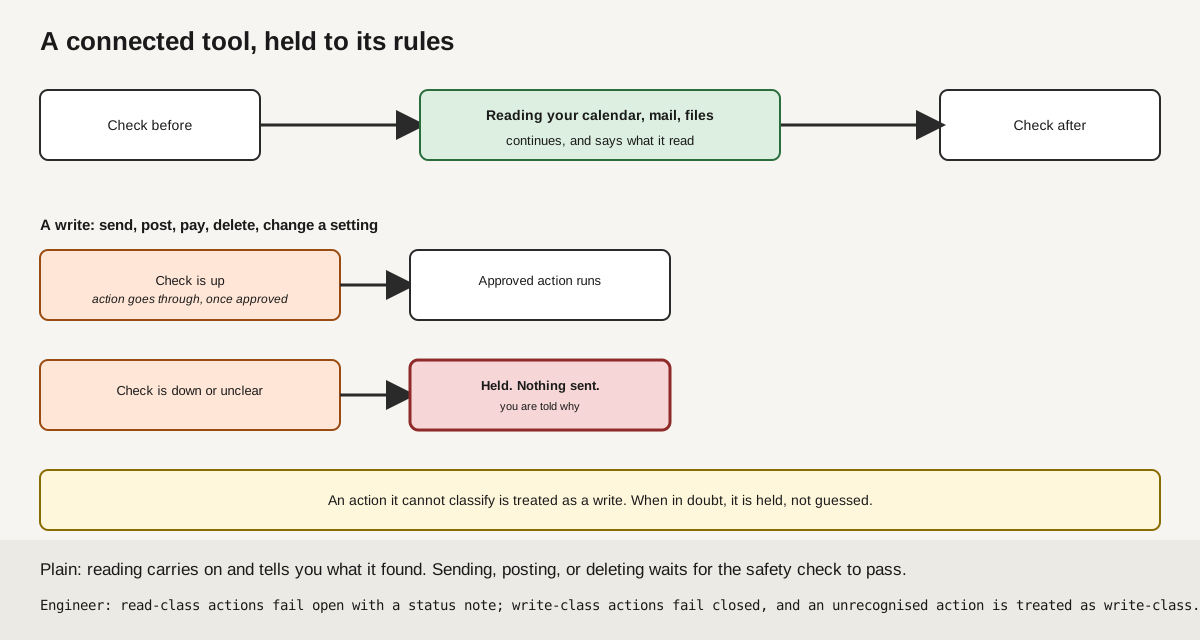
Anthropic authored the Model Context Protocol and shipped MCP as the primary Claude connector surface. DreamerOS runs a real MCP server on the gateway; when you point Claude Desktop or Claude Code at it, Claude picks up the DreamerOS tool set alongside its own - 19 tools on the free tier, rising to 40 on Elite. The authenticated Connect page supplies the account-specific setup details, and the client handshake is the proof that a connection is active.
- When returned by the live contract, DreamerOS displays available governance evidence rather than claiming every turn has the same artifacts.
- Connection and model-routing behavior are runtime-specific and must be checked from the active session rather than inferred from this page.
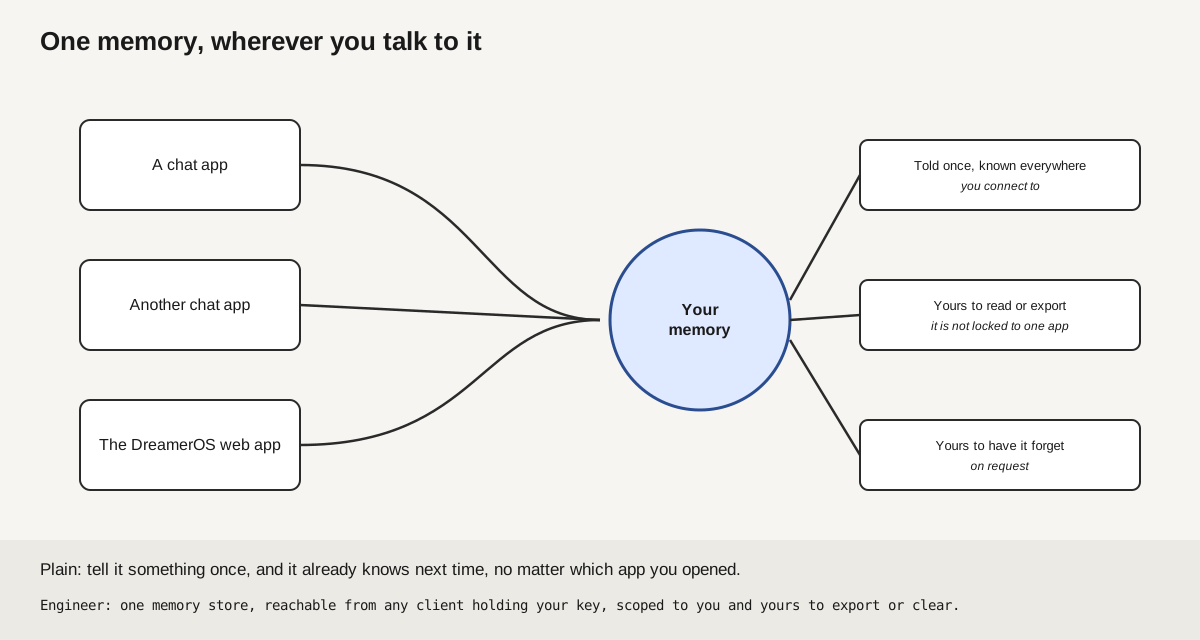
- Cross-session continuity is connection and tier dependent; preserve an evidence receipt when it matters to your workflow.
Sources: MCP was donated to the Linux Foundation Agentic AI Foundation (wikipedia). Claude Opus 5 GA with 1M context and adaptive thinking (claudefa.st).
DreamWeaver on Gemini
What DreamWeaver adds on Gemini
Gemini 3.1 Pro cut hallucination roughly in half and Google's Workspace Intelligence surface exposes Gemini as an actor across Gmail, Docs, Sheets, and Drive. Gemini's memory today is a Google-account-tied knowledge graph, not a portable operator profile.
- Portable operator fingerprint rides in alongside every Gemini turn so the same tone, depth, and risk-tolerance calibration you use in ChatGPT and Claude applies here too.
- Modality-routed checks: when a Workspace-triggered agent step fans out to Gemini's native multimodal I/O, DreamerOS runs the same IFP + DAIM pass a text turn gets.
- Cross-engine memory continuity: a decision recorded during a Gemini turn is recallable in Claude and ChatGPT without re-pasting it.
Sources: Gemini 3.1 Pro accuracy note (suprmind.ai). Workspace Intelligence launch (technology.org). Gemini Extensions catalog (support.google.com).
DreamWeaver on Grok
What DreamWeaver adds on Grok
Grok 4.5 landed with real speed and live X grounding, running on xAI's ninth-generation foundation model with a 500,000-token context window, and independent benchmarking measured the tradeoff: accuracy rose while the hallucination rate on unanswerable questions more than doubled against Grok 4. Grok got faster and more confident, including more confident when wrong, and it still has no persistent operator profile. That is exactly the gap DreamerOS closes: keep Grok's pulse, add the memory and the proof.
- Connect once, in Grok itself. xAI calls this Bring Your Own MCP. On a paid Grok plan: grok.com/connectors, New Connector, Custom, server URL
https://mcp.dreameros.app/mcp, then authorize with your DreamerOS API key. Grok discovers the DreamerOS tool surface automatically, 40 tools that run through the same intent checks, scoped to your DreamerOS plan, and the connection carries across Grok on web, iOS, and Android, without changing where you type. - Grok stops forgetting. Every Grok chat can recall your DreamerOS memory, canon, and cognitive fingerprint from message one, on every plan including free. On Dreamweaver plans your Grok also writes decisions back, so something decided in Grok is already known the next time you open Claude, ChatGPT, or Gemini.
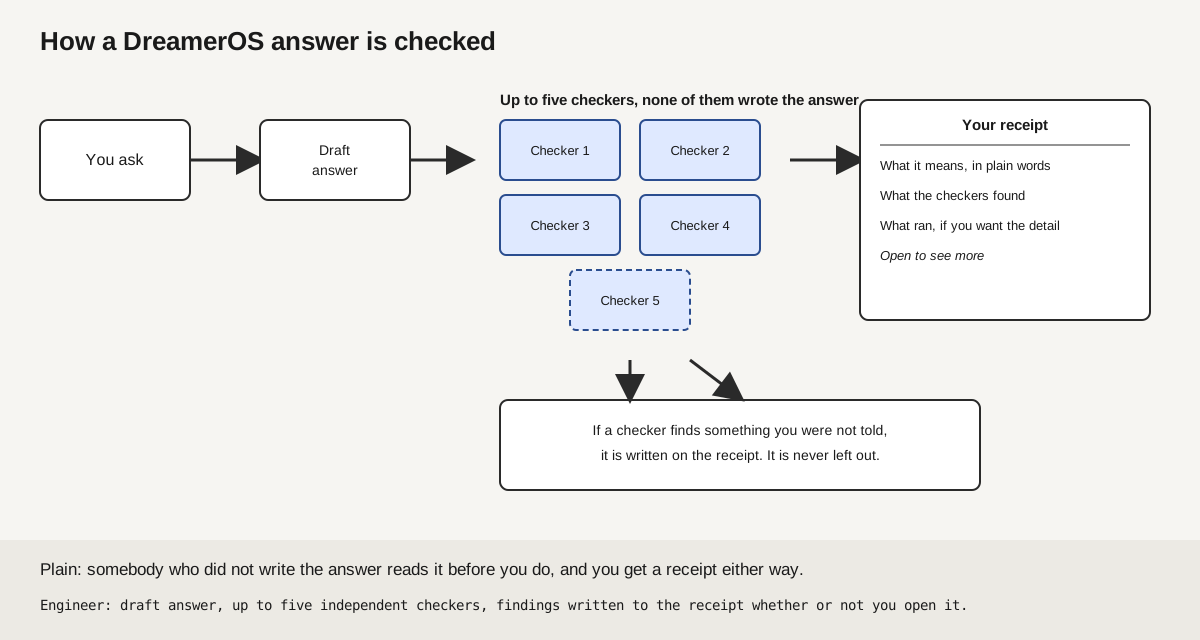
- Grok gets receipts. Run any Grok answer through the DreamerOS verification pass: hallucination check, intent fidelity score, and on Pro and above a signed receipt per checked turn. Grok brings the speed; DreamerOS brings the proof it is not bluffing.
- The constellation from inside Grok. On Pro and above, route a turn to the seat built for it: Perplexity for cited research, Claude for the integrity read, or a cross-engine consensus when a claim has to survive more than one model.
- Coding turns in Grok pick up the DreamerOS coding fingerprint: your stack, your conventions, your last decisions.
Sources: Grok 4.5 details (fullstack.com). Grok Connectors + BYO-MCP (x.ai). Remote MCP connector setup (docs.x.ai). Grok 4.5 calibration benchmark (techtimes.com).
DreamWeaver on Perplexity
What DreamWeaver adds on Perplexity
Perplexity's Sonar and Deep Research surfaces are the strongest of the five at citation-grounded answers, and Comet, the Perplexity browser agent, now runs on macOS, Windows, Android, and iOS. Perplexity's own memory posture is "stores nothing".
- Your DreamerOS Space overlay gives the "stores nothing" surface a persistent operator profile, so tone, depth, and voice canon carry into every Perplexity thread.
- Every action the Comet browser agent proposes on a page can be scored against your recorded intent before it fires, using the DreamerOS verify path.
- DreamerOS uses Perplexity as its independent citation verifier: any claim in a Claude or ChatGPT answer can be cross-checked via route consensus, and the citation trail is stored with your memory.
Sources: Perplexity 2026 model catalog and memory posture (suprmind.ai, jenova.ai). Comet browser rollout (wikipedia).
Skills DreamerOS gives your AI
Supported DreamerOS connections can expose tools such as these. The actual tool set depends on your client, tier, server version, and live connection state.
Full list: 40 tools on the gateway MCP server today, tier-gated. 19 work on the free tier; DreamWeaver Solo and Duo raise that to 24 with the memory-write set; Pro unlocks 38 and Elite all 40 with the orchestration and verification set. Authenticated Connect is the source of truth for your current client setup and available tools. MCP protocol overview: wikipedia.
Intent Fidelity for Code
Code is where intent-drift bites hardest. A model writes a working function that solves the wrong problem, or a destructive command that runs before you see it. DreamerOS puts an intent gate before execution and a sandbox receipt after it.
Before it runs: verify_code_intent
Every generated shell command or code block is scored against a destructive-token pattern set (irreversible deletes, force flags, table drops) plus a blast-radius and reversibility check. The verdict is proceed, review, or block. Pure rule-based, sub-millisecond, no LLM in the hot path.
After it runs: E2B sandbox receipt
On Pro and above, the largest fenced Python or JavaScript block in a code-domain response is executed in an E2B Firecracker sandbox with internet disabled, a ten-second per-run timeout, and a twenty-second total budget. The response ships with a signed receipt: EXECUTED_PASS, EXECUTED_FAIL, SKIPPED, or SANDBOX_UNAVAILABLE. Static gate skips interactive input, prompts, and unbounded loops.
Sandbox landscape: the OpenAI Agents SDK ships native support for E2B, Modal, Cloudflare Sandbox, Daytona, Blaxel, Runloop, and Vercel (modal.com). DreamerOS chose E2B for Firecracker microVM isolation with hardware-level boundaries (blaxel.ai).
Pick your DreamWeaver tier
Both tiers include full DreamerOS intent verification. ChatGPT is live via the DreamerOS Custom GPT today; Claude is live via MCP. The difference between Solo and Duo is how many connected engines carry your synced memory.
DreamWeaver Solo
- Full intent verification for one engine of your choice
- Persistent memory across sessions
- Automatic question shaping
- Integrity checking on every output
- Works inside ChatGPT
DreamWeaver Duo
- Two engines of your choice
- Memory syncs across both engines
- Automatic question shaping
- Integrity checking on every output
- Works inside ChatGPT
Need all five engines? DreamerOS Pro ($39.99/mo) unlocks everything.
Same tools. Intent-Verified output.
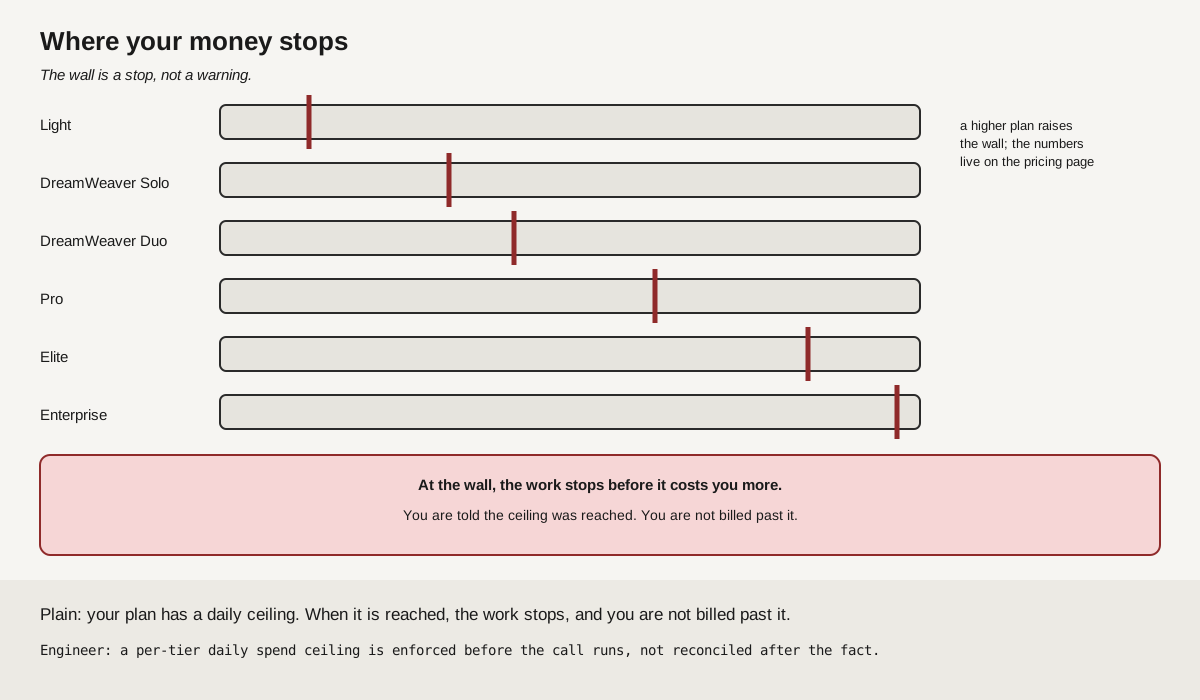
Start free with Light. Upgrade to DreamWeaver when the work gets serious.