
Docs
Four short walks. Pick the one that matches your question.
Ask and check, memory, connectors, and receipts. Each one opens a real screen from the app.
Open the DreamerOS GPT or the app and type the messiest version of your real question. Nothing to configure first.
Try it free. No card, ever.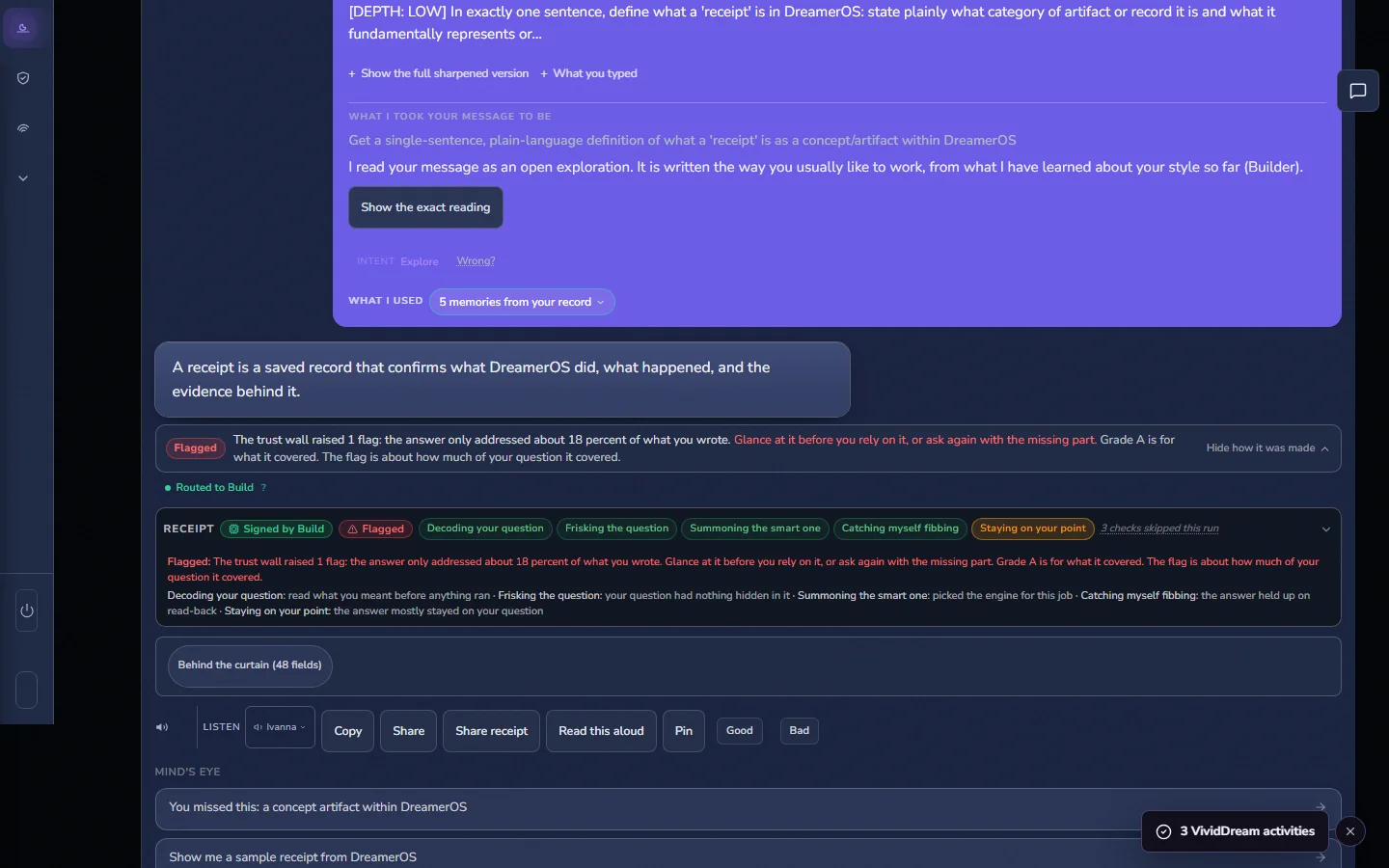
Ask and check
You ask. It checks before you ever see the answer.
This is that check happening, before the answer reaches you. Ask normally, the way you already type: in the DreamerOS GPT with no account, or in the app with a free account. The checks include a hallucination scan (did it make something up), a source check, a drift check (did it wander from your question), and a confidence check that catches a guess and marks it as a guess. You see the verdict under the answer.
How this works
Memory
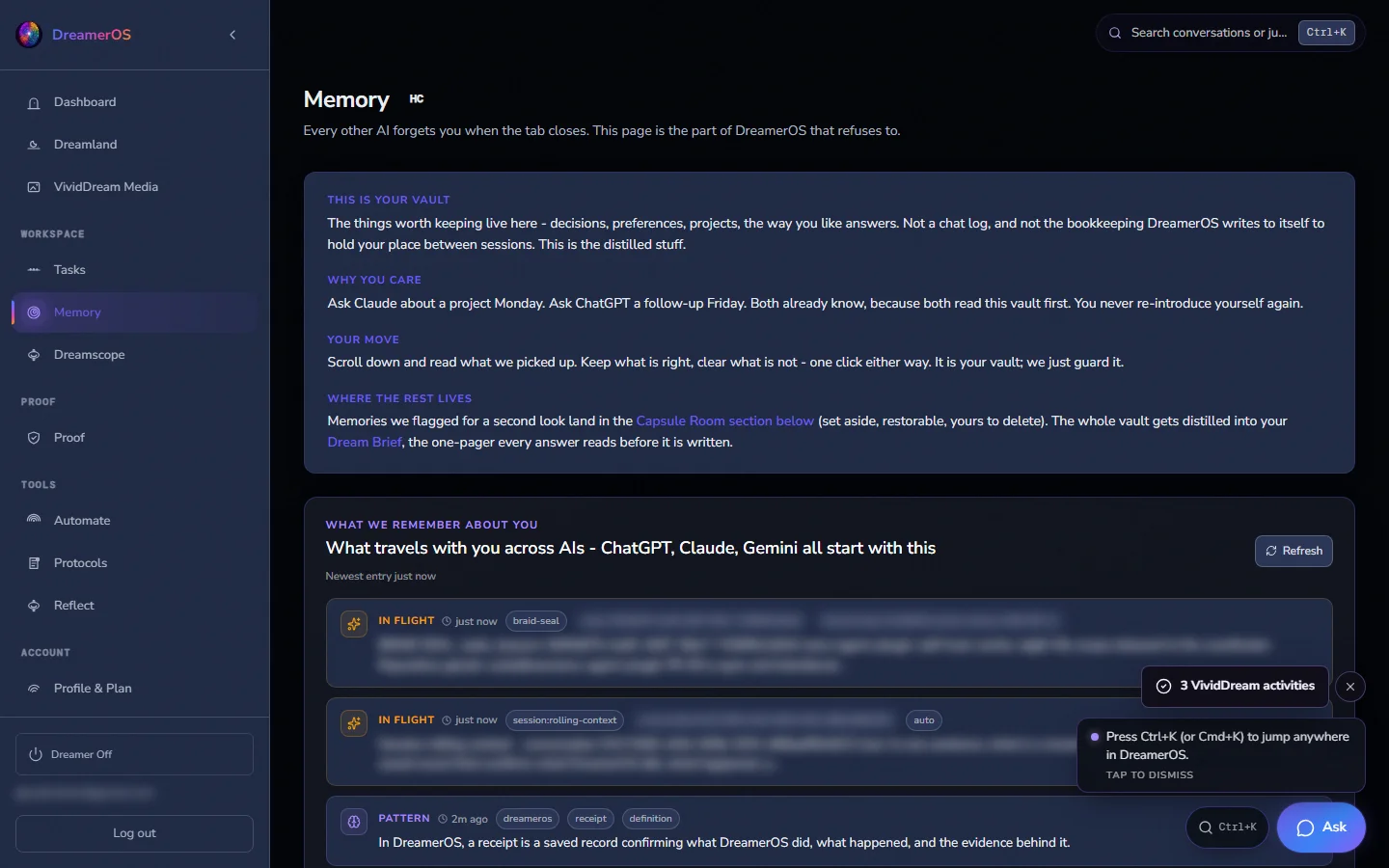
What you said in one tool is known in the next.
This is that one memory surface. Tell ChatGPT something Monday, switch to Claude Wednesday, and it already knows it. The memory lives at the DreamerOS layer, not trapped inside one vendor account, so it follows you instead of resetting every time you change tools. How much it holds depends on your plan: see what each plan includes.
How this works
Connectors
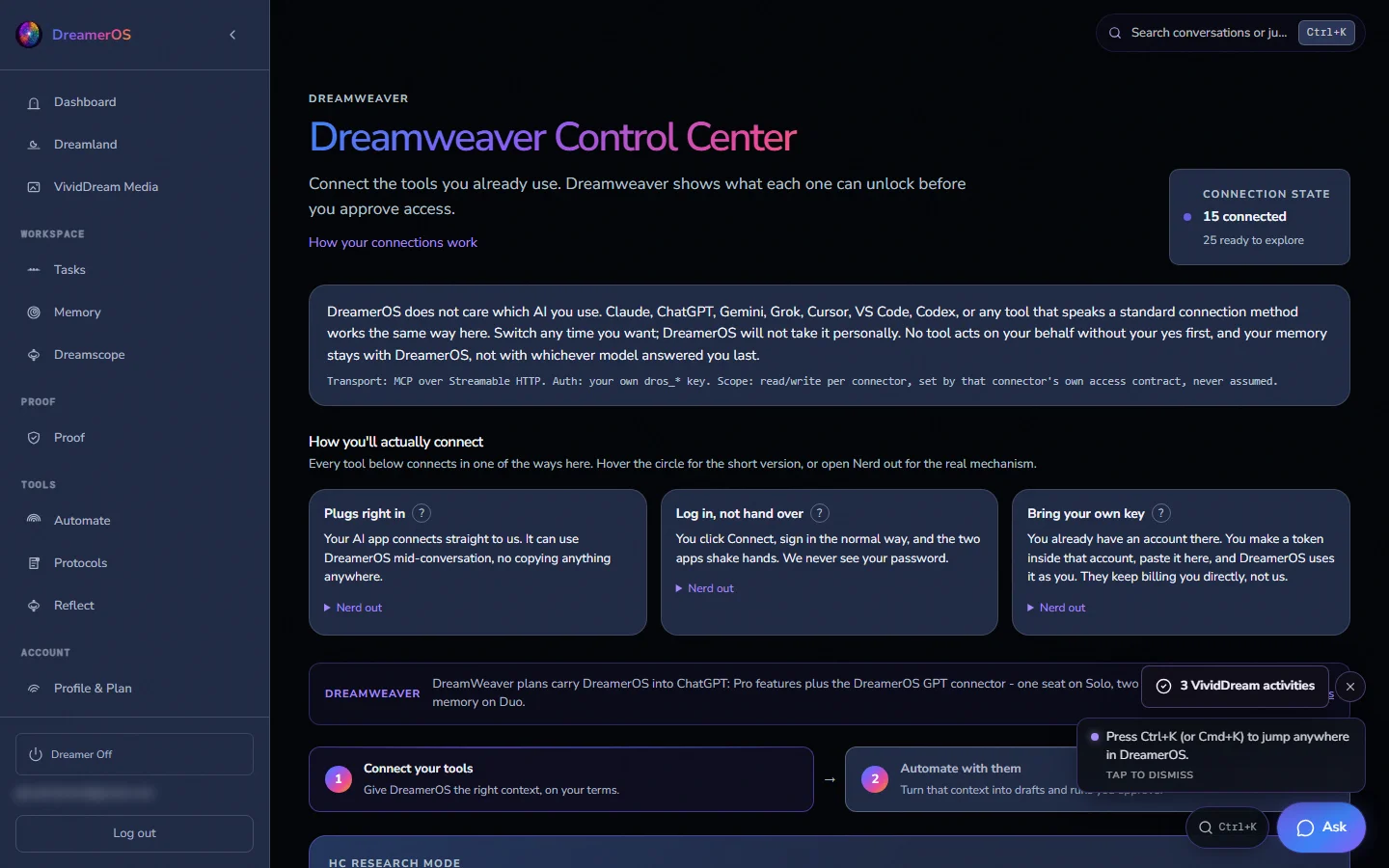
Where it connects, and what it may do there.
This is the connect screen, showing what is linked. Add DreamerOS to Claude, ChatGPT, Perplexity, or another MCP-aware client (MCP is the plug shape AI tools use to connect) with a key from your profile. Once connected, every read from that tool is treated as reading material, never as an order, and nothing it can send, post, or spend goes out without your yes.
How this works
Receipts
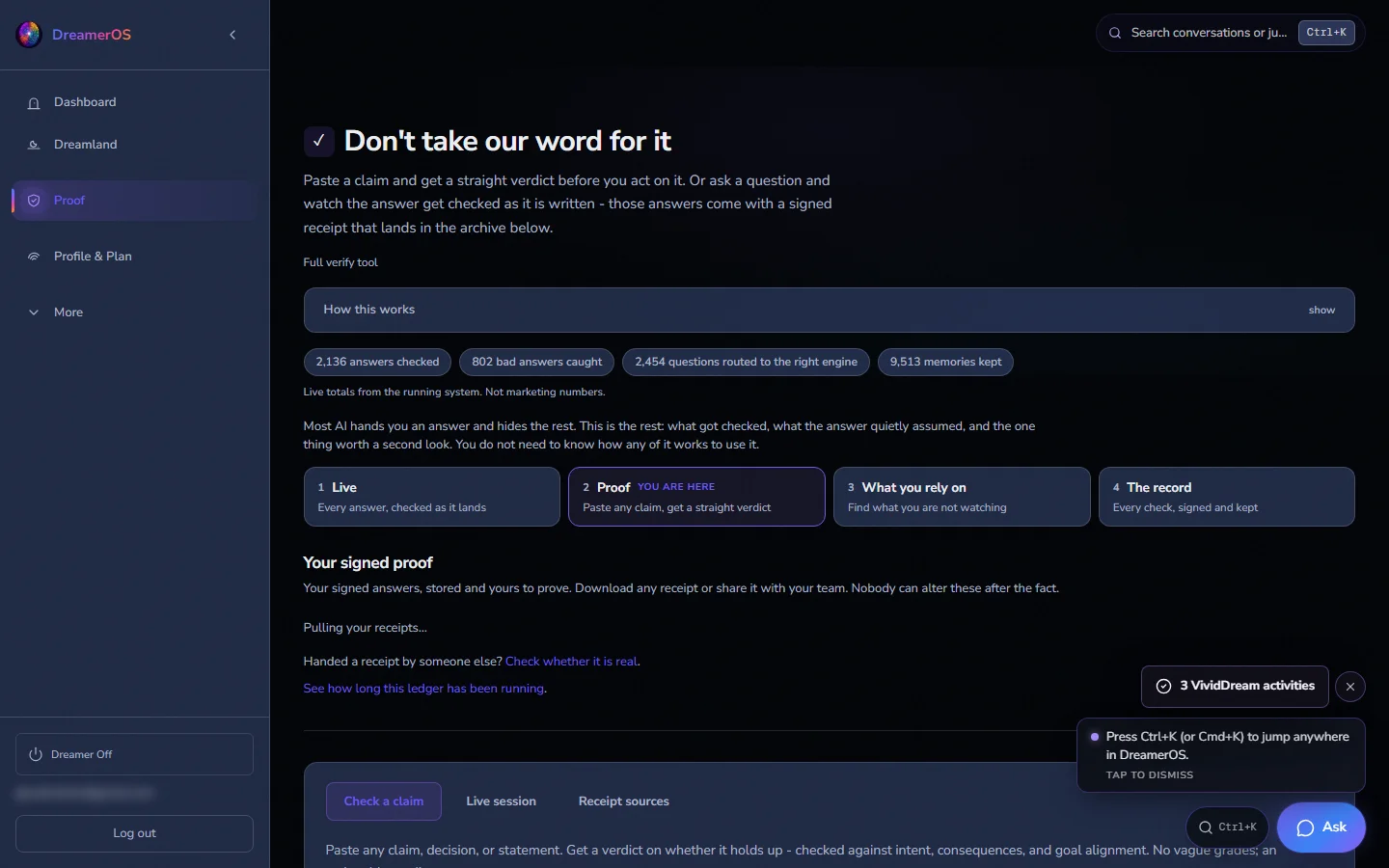
Every answer leaves a record you can open.
This is one such record, a receipt, open in three layers. Each answer writes one row: which engine answered, what it cost, which checks ran and what they found. Plain words first, so you can stop reading at the layer you need. How many receipts you get a day depends on your plan.
How this works
More reading
Full setup at getting started and your journey. The mechanism at under the hood and Intent Fidelity Protocol. Straight answers at the FAQ.
Plain words for the words on this page
Page. A single screen on this site, like the one you are reading. It is not a unit you buy and we never charge for one.
A client-side path in the web app, served over HTTPS; not a billing unit in any plan.
Token. The small pieces a computer chops your words into, about three quarters of a word each. Your plan sets how long one answer can be, counted in tokens. It does not set how many questions you may ask.
Max tokens per response, one value per plan. Each plan card lists its own.
Engine. One AI brand you can talk to. ChatGPT, Claude, Gemini, Grok and Perplexity are the five. Your plan page lists which ones you can use.
Five role names per plan (Build, Review, Synthesis, Signal, Research). Some plans count the engines you connect live, and the limit is checked on every request.
Connector. A link between DreamerOS and a tool you already use, such as Gmail, Notion, Slack, GitHub or Stripe. It lets DreamerOS read from that tool, and in some cases act in it, but only inside rules you set.
39 provider integrations on the gateway, each reached over HTTPS with a scoped, per-provider key.
Receipt. A short record attached to your answers. It names which engine answered, what it cost, which checks passed, and whether sources were checked. You never have to guess what just happened.
One record per answer, written server-side on the gateway: engine, model, plan, cost, and the pass or fail result of the pre-check and post-check.
Memory. The facts about you that DreamerOS keeps and reuses next time, so you stop repeating yourself. Your plan sets how many facts it holds.
Active memory rows per plan, with a smaller fallback for a session with no plan set yet. Each plan card lists its own.
MCP key. A key you paste into another app, such as Claude Desktop or Cursor, so DreamerOS memory and checks work there too. You do not have to change where you already work.
A signed key. Individual tools inside it may carry a plan floor.
Intent fidelity. Checking that the answer answers the question you actually asked, not a nearby one that was easier.
A rule-based check that runs on the gateway, scored on three axes, with no separate model call.
Direction set. The standing written instructions DreamerOS gives every engine before it sees your question, so all five behave the same way.
One canonical system prompt, loaded by the gateway and sent to every engine.
Direction Set Workshop. Every new AI tool makes you explain yourself from scratch: how you decide, how deep you want answers, what you will not put up with. DreamerOS learns that from how you use it. The Workshop turns it, plus your own rules, into text you paste into any of 21 other AI tools, so they start from what DreamerOS knows instead of from zero. It is a paste, not a live link, so over a long chat the other tool can still drift. Inside DreamerOS, every answer is checked.
POST /api/v1/direction-set/assemble reads your cognitive_fingerprint record and returns plain text for the tool you pick; presets save named versions.
Check. A test run on your question before the engine sees it, and on the answer before you see it.
A pre-check before the engine sees your question, and a post-check before you see the answer; both results ride the receipt.