
FAQ
Ask us the thing you are actually worried about.
Not a list of features. The five questions people ask before they trust a new AI tool with anything real.
Each answer below matches the plan and the rules you would actually get if you signed up right now.
Try it free. No card, ever.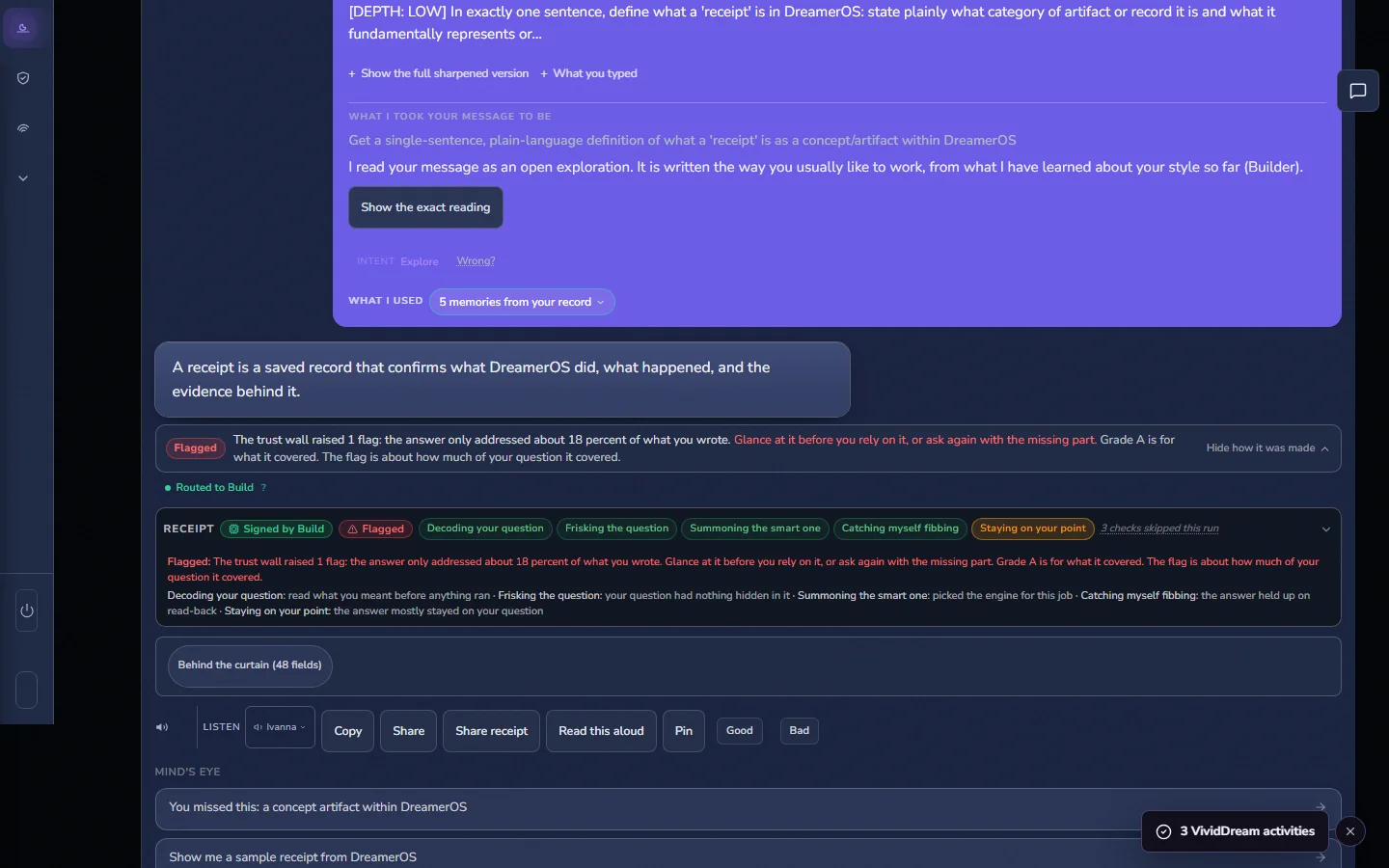
Is it safe
Your data, and your actions, do not leave your hands by accident.
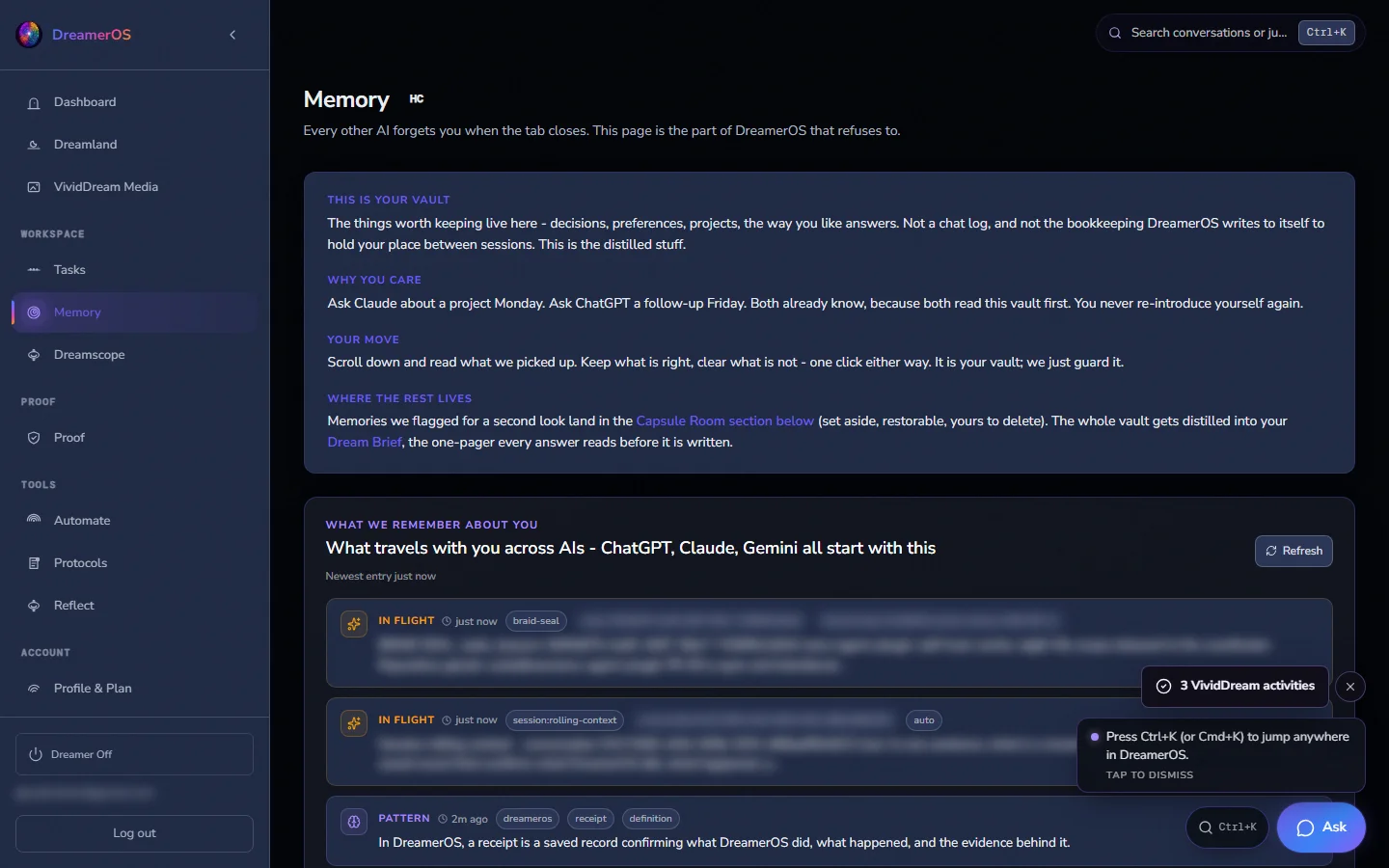
This is the settings screen, where your export lives and an account deletion starts.
Is my data encrypted? Yes, moving and at rest, so a copy of the database is not a plain-text copy of your conversations.
Who can see my memories or chats? Only you. Staff cannot open them without your authorization, and nothing here trains anyone else's model. Read how we handle your data.
Can I delete everything? Yes. A single memory goes when you delete it. For the whole account, your sign-in ends right away, and your memories, conversations and files are erased 30 days after that. Copies inside our nightly backups age out on their own schedule. Ask from the email address on your account and we will confirm it. Event records with no text in them stay, so the account history stays consistent; no words you wrote stay.
Will it email, post, or spend on its own? No. Every action is checked against what you asked, and every plan has a spend ceiling the work stops at. Anything read from a connected tool is reading material, never an instruction.
How this works
What does it remember
What you said in one tool is known in the next.
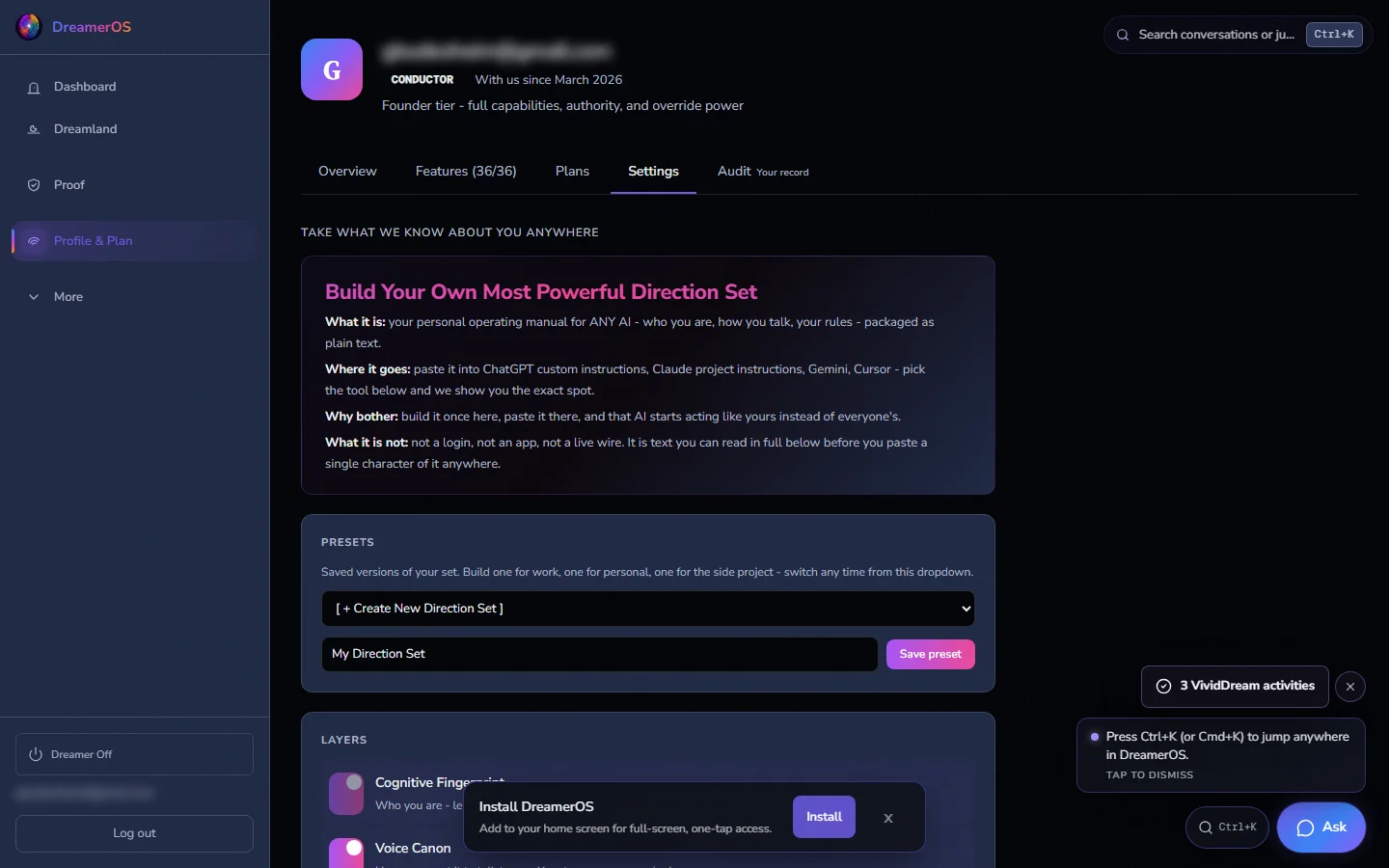
This is the memory surface every connected tool reads from.
Does it remember me across ChatGPT, Claude, and the app? Yes. Tell it something once and every engine you connect already knows it next time.
Can I export my memory? Yes, on every tier, in JSON. Leaving with everything you put in is a right here, not something you unlock by paying.
Can I make it forget something? Yes, at any size: one memory, a tag, or everything at once. Forget is a real tool here, the same way remember is.
How much can it hold? That depends on your plan; the plans page lists each one.
How this works
What does it cost
Free stays free. Paid buys depth, not access.
Start free, and pay only when you want more.
Is DreamerOS free? Light is, permanently, with no card.
What do I get if I pay? More memory, higher limits, and extras such as spoken answers and image editing. The MCP connector comes with every plan, free included.
Can I cancel any time? Yes, on a paid plan. Open the Plans screen in the app and press Manage billing. That opens the Stripe billing portal, where you can change your payment method, see invoices and cancel the subscription. If the button does not open, the same screen has a support email link. Light is free, so it has nothing to cancel. Nothing locks you in.
What happens to my data if I cancel? It stays yours to export for a while, then it is removed per the retention policy. Export it in Settings before then.
How this works

Which AI answers me
Five engines. It picks the one built for your question.
This is an answer with its engine and receipt visible.
Which engines can answer me? ChatGPT, Claude, Gemini, Grok, and Perplexity, each doing the job it is actually best at.
Do I pick, or does it pick? By default it picks automatically. On a connected engine you can teach it to always use the one you choose.
Does it tell me which one answered? Yes. The receipt on the answer (the short record attached to every answer) names the engine and what it checked.
Can today's question get a different engine than yesterday's? Yes, on purpose. A weather question and a contract question do not want the same engine, so engine choice changes with the question, not with the day.
Read more
The full mechanism lives at under the hood, the setup steps at getting started, and the plan comparison at plans. Still stuck? Talk to us.
Plain words for the words on this page
Page. A single screen on this site, like the one you are reading. It is not a unit you buy and we never charge for one.
A client-side path in the web app, served over HTTPS; not a billing unit in any plan.
Token. The small pieces a computer chops your words into, about three quarters of a word each. Your plan sets how long one answer can be, counted in tokens. It does not set how many questions you may ask.
Max tokens per response, one value per plan. Each plan card lists its own.
Engine. One AI brand you can talk to. ChatGPT, Claude, Gemini, Grok and Perplexity are the five. Your plan page lists which ones you can use.
Five role names per plan (Build, Review, Synthesis, Signal, Research). Some plans count the engines you connect live, and the limit is checked on every request.
Connector. A link between DreamerOS and a tool you already use, such as Gmail, Notion, Slack, GitHub or Stripe. It lets DreamerOS read from that tool, and in some cases act in it, but only inside rules you set.
39 provider integrations on the gateway, each reached over HTTPS with a scoped, per-provider key.
Receipt. A short record attached to your answers. It names which engine answered, what it cost, which checks passed, and whether sources were checked. You never have to guess what just happened.
One record per answer, written server-side on the gateway: engine, model, plan, cost, and the pass or fail result of the pre-check and post-check.
Memory. The facts about you that DreamerOS keeps and reuses next time, so you stop repeating yourself. Your plan sets how many facts it holds.
Active memory rows per plan, with a smaller fallback for a session with no plan set yet. Each plan card lists its own.
MCP key. A key you paste into another app, such as Claude Desktop or Cursor, so DreamerOS memory and checks work there too. You do not have to change where you already work.
A signed key. Individual tools inside it may carry a plan floor.
Intent fidelity. Checking that the answer answers the question you actually asked, not a nearby one that was easier.
A rule-based check that runs on the gateway, scored on three axes, with no separate model call.
Direction set. The standing written instructions DreamerOS gives every engine before it sees your question, so all five behave the same way.
One canonical system prompt, loaded by the gateway and sent to every engine.
Direction Set Workshop. Every new AI tool makes you explain yourself from scratch: how you decide, how deep you want answers, what you will not put up with. DreamerOS learns that from how you use it. The Workshop turns it, plus your own rules, into text you paste into any of 21 other AI tools, so they start from what DreamerOS knows instead of from zero. It is a paste, not a live link, so over a long chat the other tool can still drift. Inside DreamerOS, every answer is checked.
POST /api/v1/direction-set/assemble reads your cognitive_fingerprint record and returns plain text for the tool you pick; presets save named versions.
Check. A test run on your question before the engine sees it, and on the answer before you see it.
A pre-check before the engine sees your question, and a post-check before you see the answer; both results ride the receipt.