
Plans
You do not pay until the free plan stops being enough.
Start free, with no card, and every plan card shows its limits before you pick it. DreamerOS remembers your work, checks the answer on the way back, and leaves you a receipt: a short record of what was checked.
Free stays free. The diagram shows the point where engine work stops before it can cost more, and the five plan cards below show the engine count, memory, and receipt limit for each choice before you reach it. The next step up is $14.00/mo.
Try it free. No card, ever.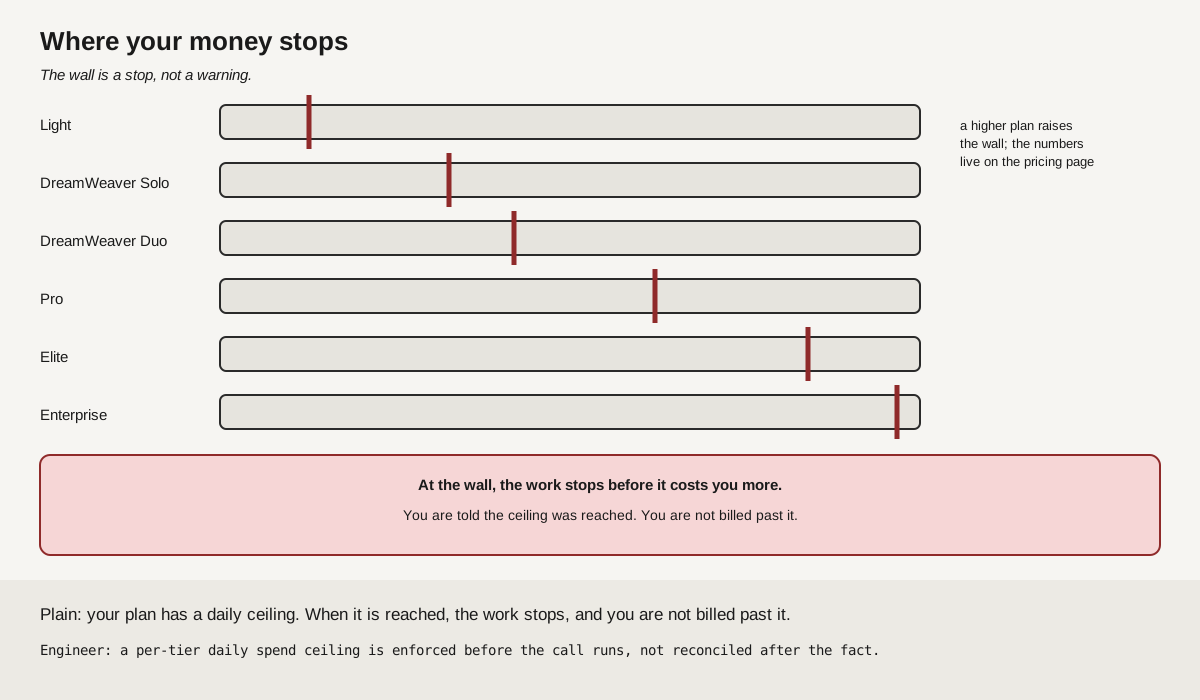
| Light | DreamWeaver Solo | DreamWeaver Duo | DreamerOS Pro | DreamerOS Elite | |
|---|---|---|---|---|---|
| Price | Free | $14.00/mo | $24.99/mo | $39.99/mo | $149.00/mo |
| Engines | 5 | 1 | 2 | 5 | 5 |
| Memory rows | 100 | 1,000 | 1,000 | 10,000 | 100,000 |
| Requests an hour | 10 | 50 | 50 | 100 | 500 |
| Receipts a day | 25 a day | no daily cap | no daily cap | no daily cap | no daily cap |
Light
Light: Free
Light costs nothing, and it is not a trial.
No card, and no clock running out.
Light needs a free account. The free reflection on this site needs none.
Ask a question and DreamerOS picks which engine answers it, from all five engines. You can also pick one yourself.
The normal path checks your question before an engine answers and checks the answer on the way back, shows which checks ran, and gives you a receipt to keep.
If a receipt cannot be made, the answer still comes back and says so.
It holds up to 100 things about you. Your receipts are capped at 25 a day.
When the daily receipt cap starts getting in your way, that is the day Solo pays for itself.
- Light engines: all five engines
- Memory: remembers 100 things about you
- Receipts: 25 a day
- Speed: 10 requests an hour
- In your own tools: yes, an MCP key is included
- Voice and media: images you create, and text read out of a picture
- Audio: one transcriber on your recordings
- Longest answer: up to 1,024 tokens
Available on higher tiers: automations, video creation, three transcribers on your audio, deep claim checks, the Direction Set Workshop, a live ops feed, whole documents read aloud, spoken answers or image editing. Ask for one without changing plan.
Solo
Solo: $14.00/mo
Solo is for the one engine you trust. Pick ChatGPT, Claude, Gemini, Grok or Perplexity and keep it. Solo holds 1,000 things about you instead of Light's 100, and you can tell it what to remember, which Light cannot. Every plan checks the answer; Solo adds two extras: it can hold back a flagged answer, and it takes personal data out of the answer.
- Solo engines: 1 connected engine: pick from ChatGPT, Claude, Gemini, Grok, Perplexity
- Memory: remembers 1,000 things about you
- Receipts: no daily cap
- Speed: 50 requests an hour
- In your own tools: yes, an MCP key is included
- Voice and media: spoken answers, documents read aloud, images created and edited, and text read out of a picture
- Audio: two transcribers, stitched on your recordings
- Longest answer: up to 2,048 tokens
Available on higher tiers: automations, video creation, three transcribers on your audio or a live ops feed. Ask for one without changing plan.
Duo
Duo: $24.99/mo
Duo gives you two chosen engine families instead of one. Both can use account memory on supported paths, and DreamerOS picks between them for each question. Duo keeps the same 1,000 memories as Solo, twice the coverage, one shared record. You can also compare what your two engines say. Sending one question to all five engines at once starts at Pro.
- Duo engines: 2 connected engines: pick from ChatGPT, Claude, Gemini, Grok, Perplexity
- Memory: remembers 1,000 things about you
- Receipts: no daily cap
- Speed: 50 requests an hour
- In your own tools: yes, an MCP key is included
- Voice and media: spoken answers, documents read aloud, images created and edited, and text read out of a picture
- Audio: two transcribers, stitched on your recordings
- Longest answer: up to 2,048 tokens
Available on higher tiers: automations, video creation, three transcribers on your audio or a live ops feed. Ask for one without changing plan.
Pro
Pro: $39.99/mo
Pro makes all five engines available and lets DreamerOS pick one for what you asked, unless the question is one that goes to several at once. Pro remembers 10,000 things about you. Your connected tools can draft work and, where you have allowed it, carry it out. Upload a file, an image or a recording and the page tells you whether it was read or turned down. Pro adds priority engine choice and memory orchestration. This is the strongest individual plan before team controls.
- Pro engines: all five engines
- Memory: remembers 10,000 things about you
- Receipts: no daily cap
- Speed: 100 requests an hour
- In your own tools: yes, an MCP key is included
- Voice and media: spoken answers, documents read aloud, sharper images created and edited, and text read out of a picture
- Audio: three transcribers on your recordings
- Longest answer: up to 5,000 tokens
Available on higher tiers: video creation or a live ops feed. Ask for one without changing plan.
Team management, role-based access, shared outputs and priority support stay with Elite.
Elite
Elite: $149.00/mo
Elite is a team plan carrying one price for everyone on it. The whole team shares one audit trail and one memory policy, so the work reads the same no matter who on the team asked it, with role based access on top. Elite memory climbs to 100,000 and requests to 500 an hour, past what one person alone will ever need. Elite is for what a team needs and one person does not: a shared record, roles and priority support, with video creation and a live ops feed on top.
- Elite engines: all five engines
- Memory: remembers 100,000 things about you
- Receipts: no daily cap
- Speed: 500 requests an hour
- In your own tools: yes, an MCP key is included
- Voice and media: spoken answers, documents read aloud, the sharpest images created and edited, video you make, and text read out of a picture
- Audio: three transcribers on your recordings
- Longest answer: up to 10,000 tokens
Start Elite Talk to us about Elite
On every plan, Light included
Every answer is checked on the way back. Checks run on the answer, DreamerOS checks it still matches what you asked, and when the outside check runs, an AI from a different maker reviews it. See what runs.
DreamerOS picks the engine for each question. On Light, Pro and Elite you can also pick any of the five yourself; Solo and Duo pick from the engines you connected. How engines are picked.
DreamerOS keeps what it learns from your chats between sessions, up to your plan's limit. A session with no plan set yet uses a smaller fallback of 25 rows. How memory works.
Receipts are signed on every plan: 25 a day on Light, no daily cap on paid plans. Check a receipt.
Every plan has an MCP key and an API key, the same 37 skills you call by name, a way to export all your data or delete your account, and a record of what DreamerOS decided and why. Reading that record needs no plan above Light.
Text in a picture is read on every plan. Paid plans use a stronger reader, and Pro and Elite can ask for a slower, sharper read that checks itself with a second look.
When DreamerOS checks a fact on the web, Light uses a standard web search, paid plans search deeper, and Elite runs a full research search. Solo and Duo are explained on the DreamWeaver page.
Paid plans only: free reflections on this site stop at one a day, and paid plans have no such limit. The Direction Set Workshop exports your rules into 21 other AI tools through one gate, with no per-vendor limit.
A plan named on this page is the plan the running system checks against today, not the plan we intend to move a feature to.
post-checks, intent check, second opinion: no tier test | hand pick: any plan, connected engines only on Solo and Duo | receipts: Light capped daily | export, delete: signed in | direction set export: 21 vendor formats, one gate for all paying plans | engine count and transcribers set per plan, MCP tools filtered per plan at call time
Add one without changing plan
Six add-ons have a button on the Plans screen in the app: Automations, Three transcribers on your audio, Deep claim check, Direction Set Workshop, Live ops feed and One more connection. The app also lists four more that no card above names: Receipts on every answer, Idea notary, Web actions and More memory.
Pressing a button only records that you want it. It does not charge you, it does not change your plan, and it does not switch the thing on. We count how many people press each one, and we read that count before deciding anything. Pressing twice still counts as one person.
What these words mean for your plan
Engine - the AI model that writes an answer, such as ChatGPT, Claude, Gemini, Grok or Perplexity. On the cards above, the engine count is how many of them your plan can reach. On Solo and Duo the count comes from the engines you connected, and DreamerOS checks it against your plan limit on every request.
MCP key - a key you paste into another AI tool, such as Claude or Cursor, so it can use your DreamerOS memory and checks. MCP is the standard way an AI tool plugs into an outside service. Every plan includes one; a few tools inside it need a higher plan.
Direction Set Workshop - a page in the app where you write your working rules and voice once, then export them into 21 other AI tools.
Live ops feed - one feed of your errors, deploys and events across the services you connected.
POST /api/v1/api-key/generate | dros_ bearer key | MCP over HTTPS | your account only; POST /api/v1/direction-set/assemble and presets | session auth | Solo and up; GET /api/v1/dashboard/cross-service-feed | session auth | Elite
Compared to the alternatives
OpenRouter is a usage-priced model marketplace that sends each call to one of many models. DreamerOS is a monthly account that carries your intent, your memory, the checks, and the receipts. They can work together; they are not the same product.
ChatGPT Plus sells access to OpenAI's consumer product. DreamerOS Pro makes all five engines available through DreamerOS for $39.99/mo, with deeper verification and account memory. Compare current provider pricing separately because it can change.
A raw provider API key supplies model access. DreamerOS adds the memory, a check on your question and on the answer, and the receipt. From DreamWeaver Solo up, a flagged answer can also be held back and personal data in it removed.
Plain words for the words on this page
Page. A single screen on this site, like the one you are reading. It is not a unit you buy and we never charge for one.
A client-side path in the web app, served over HTTPS; not a billing unit in any plan.
Token. The small pieces a computer chops your words into, about three quarters of a word each. Your plan sets how long one answer can be, counted in tokens. It does not set how many questions you may ask.
Max tokens per response, one value per plan. Each plan card lists its own.
Engine. One AI brand you can talk to. ChatGPT, Claude, Gemini, Grok and Perplexity are the five. Your plan page lists which ones you can use.
Five role names per plan (Build, Review, Synthesis, Signal, Research). Some plans count the engines you connect live, and the limit is checked on every request.
Connector. A link between DreamerOS and a tool you already use, such as Gmail, Notion, Slack, GitHub or Stripe. It lets DreamerOS read from that tool, and in some cases act in it, but only inside rules you set.
38 provider integrations on the gateway, each reached over HTTPS with a scoped, per-provider key.
Receipt. A short record attached to your answers. It names which engine answered, what it cost, which checks passed, and whether sources were checked. You never have to guess what just happened.
One record per answer, written server-side on the gateway: engine, model, plan, cost, and the pass or fail result of the pre-check and post-check.
Memory. The facts about you that DreamerOS keeps and reuses next time, so you stop repeating yourself. Your plan sets how many facts it holds.
Active memory rows per plan, with a smaller fallback for a session with no plan set yet. Each plan card lists its own.
MCP key. A key you paste into another app, such as Claude Desktop or Cursor, so DreamerOS memory and checks work there too. You do not have to change where you already work.
A signed key. Individual tools inside it may carry a plan floor.
Intent fidelity. Checking that the answer answers the question you actually asked, not a nearby one that was easier.
A rule-based check that runs on the gateway, scored on three axes, with no separate model call.
Direction set. The standing written instructions DreamerOS gives every engine before it sees your question, so all five behave the same way.
One canonical system prompt, loaded by the gateway and sent to every engine.
Check. A test run on your question before the engine sees it, and on the answer before you see it.
A pre-check before the engine sees your question, and a post-check before you see the answer; both results ride the receipt.